


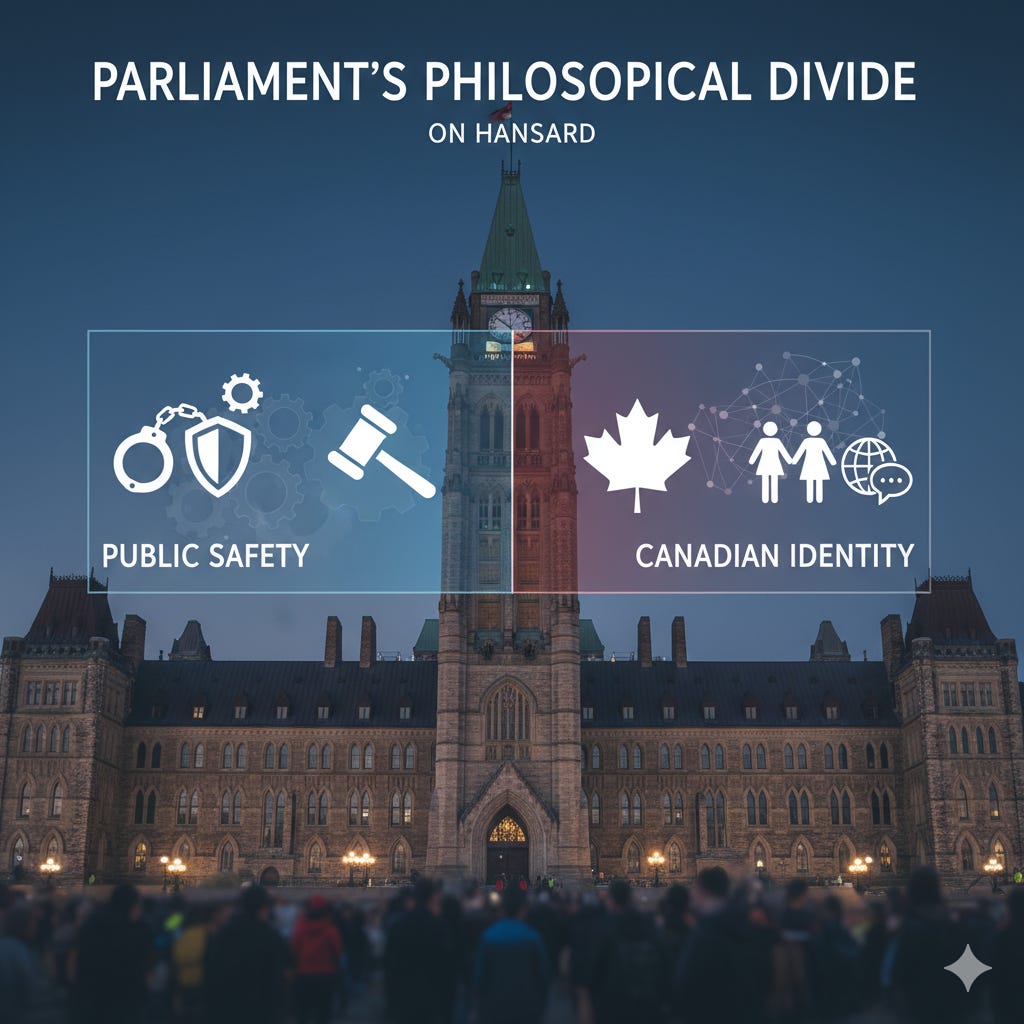
The House of Commons is back in full legislative swing, and the new government’s agenda is already encountering significant friction. While economic anxieties dominated Question Period, this week’s primary debates moved to foundational questions of Canadian identity, justice, and public safety.
The government introduced its new bail reform package, Bill C-14, framing it as a direct response to calls from premiers and police for safer communities. Simultaneously, heated debates continued over the very definition of “Canadian,” with fights over Bill C-3 (Citizenship Act) and Bill C-245 (Canadian Multiculturalism Act).
Here is a breakdown of the core arguments shaping Parliament.
The Fight Over Bail Reform
The government’s signature new legislation is Bill C-14, the Bail and Sentencing Reform Act. Tabled in response to widespread public concern over “catch-and-release” policies, the bill aims to make it harder for repeat violent offenders to get bail.
What the Bill Proposes
According to Justice Minister Sean Fraser and his parliamentary secretaries, the bill is a balanced, Charter-compliant plan developed after extensive consultation with provinces, police, and mayors.
It proposes over 80 amendments, but the core changes are:
Principle of Restraint: The bill “clarifies” the principle of restraint (introduced in 2019’s Bill C-75) by stating it does not mean automatic release, especially if public safety is at risk.
New Reverse Onuses: The bill shifts the burden of proof onto the accused to show why they should be released for specific serious offenses, including violent auto theft, home invasions, human trafficking, and sexual assault involving choking.
New Sentencing Rules: It adds “aggravating factors” for crimes against first responders and organized retail theft. It also restricts the use of house arrest (conditional sentences) for serious sexual assaults, especially those against children.
The Opposition Response
The Conservative Party, while supporting the bill’s move to committee, argues it is a “half-measure” and an “admission of guilt.”
Conservative members, including former Crown prosecutor Larry Brock, argue that Bill C-14 only “tinkers” with the problem. Their view is that the crisis was created by the Liberals’ own previous laws: Bill C-75, which codified the principle of restraint, and Bill C-5, which removed mandatory minimum sentences for many serious crimes.
The Conservatives’ key criticism is that Bill C-14 does not repeal the principle of restraint; it only clarifies it. They are pushing for their own “jail not bail” act, which would replace the principle of restraint with a “public safety primacy clause.”
The NDP and Bloc Québécois (BQ) have raised different concerns. Both parties noted that over 70% of people in provincial jails are in pre-trial detention, meaning they were denied bail and have not been convicted. They warn that expanding the reverse onus regime risks violating the Charter and will worsen the staggering overrepresentation of Indigenous and racialized people in the justice system.
What Does It Mean to Be Canadian?
Beyond public safety, Parliament is tied in knots over two bills that strike at the heart of Canadian identity.
Bill C-3: “Birthright” vs. “Canadians of Convenience”
The debate over Bill C-3 (Citizenship Act) has become a flashpoint. The core issue is the “first-generation limit,” which prevents Canadians who were born abroad from passing citizenship to their own children born abroad.
The government’s bill seeks to replace this limit with a “substantial connection” test: the Canadian parent must have cumulatively spent 1,095 days (three years) in Canada at any point in their life.
But at committee, the Conservatives and Bloc joined forces to pass amendments, making the bill much stricter. Their amendments require:
The 1,095 days of presence to be within a five-year period (harmonizing it with the naturalization process).
Applicants to pass language, knowledge, and security checks.
The government is now trying to remove these amendments. Liberals argue that citizenship by descent is a birthright, not immigration, and that adding tests creates “different classes of citizens.” Liberals also cited a 1997 Supreme Court ruling and a 2007 committee report (under the Harper government) suggesting security checks are not appropriate for birthright citizenship.
Conservatives and the Bloc counter that the government’s un-amended bill devalues citizenship, creating “Canadians of convenience” who have no real connection to Canada but can draw on its resources.
Bill C-245: Multiculturalism vs. Interculturalism
A BQ private member’s bill, C-245, proposes to exempt Quebec from the federal Canadian Multiculturalism Act.
BQ MP Xavier Barsalou-Duval argued that multiculturalism, a policy of Pierre Elliott Trudeau, is a “tower of Babel” and a “policy of disintegration” designed to deny Quebec’s nationhood. He contrasted it with Quebec’s own model of “interculturalism,” which is based on integrating immigrants into a common, French-speaking culture.
Liberals and Conservatives united to oppose the bill. Conservative MP Gérard Deltell defended the act, noting it was passed by a Quebecker, Brian Mulroney, as a tool for equal rights, not division. Liberals argued that multiculturalism and bilingualism are complementary and that the BQ’s bill would create “two classes of citizenship.”
The Economic Stalemate
In Question Period, the economy remained the dominant issue, perfectly captured by the fight over a new Food Banks Canada report.
Both the Conservatives and the BQ used the report’s headline finding—that food bank use has doubled in the last 10 years—as proof that “the more [Liberals] spend, the more things cost.” They blame “inflationary deficits” for the crisis.
The Liberals, in response, also quoted the Food Banks Canada report. They claim the report praises their social programs (like the dental care plan and school food program) as “essential” and “showing early promise.” The Liberals then accused the Conservatives of voting against the very solutions the report calls for.
This has become the central theme of the fall sitting: the opposition demands an “affordable budget,” while the government warns that voting against their upcoming budget will trigger a “costly Christmas election.”
The Data Brief
Bill C-14 (Bail Reform): The government’s new bill makes bail harder to get for repeat violent offenders by expanding the “reverse onus” to new offenses (e.g., auto theft, home invasion) and restricting house arrest for sexual assault.
The Opposition: Conservatives say the bill is a “half-measure” that fails to repeal the “principle of restraint” from Bill C-75, which they see as the root of the problem. The BQ and NDP raised Charter concerns and the impact on over-incarceration rates.
Bill C-3 (Citizenship): The government is fighting to remove committee amendments from its own bill. The debate is a philosophical clash over whether citizenship by descent is an automatic “birthright” (Liberal view) or an “earned privilege” that requires strict connection tests (CPC/BQ view).
Bill C-245 (Multiculturalism): The BQ bill to exempt Quebec was debated, pitting Quebec’s “interculturalism” (integration into a common French culture) against the federal model of multiculturalism.
Economic Debate: Both the government and the opposition are using the same Food Banks Canada report to prove opposite points about the economy and the success (or failure) of federal social programs.
Parole Reform (PMB): Bill C-243, a Conservative private member’s bill, proposes changing parole hearings for convicted murderers from every year to every five years, citing the trauma to victims’ families. Liberals and the BQ raised concerns that this may violate the Charter.
Source Documents
House of Commons Debates, Official Report (Hansard), 45th Parliament, 1st Session, Vol. 152, No. 044, Monday, October 27, 2025.
House of Commons Debates, Official Report (Hansard), 45th Parliament, 1st Session, Vol. 152, No. 045, Tuesday, October 28, 2025.
House of Commons Debates, Official Report (Hansard), 45th Parliament, 1st Session, Vol. 152, No. 046, Wednesday, October 29, 2025.
House of Commons Debates, Official Report (Hansard), 45th Parliament, 1st Session, Vol. 152, No. 047, Thursday, October 30, 2025.
House of Commons Debates, Official Report (Hansard), 45th Parliament, 1st Session, Vol. 152, No. 048, Friday, October 31, 2025.