


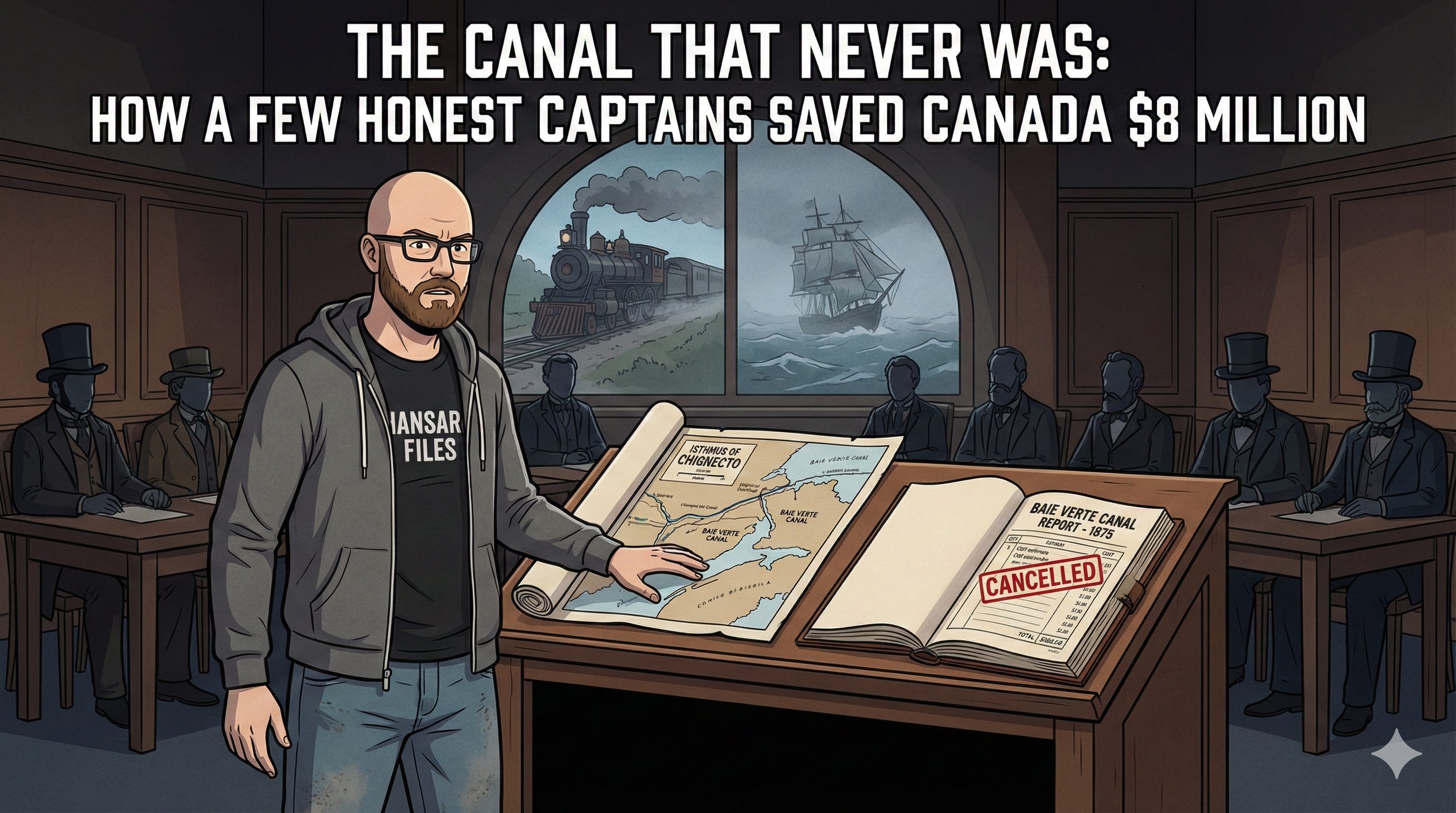
The map of Canada contains a tantalizing geometric flaw. At the border of New Brunswick and Nova Scotia, the Atlantic Ocean punches inland, narrowing the solid earth to a slender eighteen-mile strip known as the Isthmus of Chignecto. On one side churn the violent, mud-red tides of the Bay of Fundy. On the other lie the calm, ice-blue waters of the Gulf of St. Lawrence.
For fifty years, merchants and engineers looked at this narrow neck of land and saw a shortcut worth a fortune. If they could just dig a ditch across it, they could bypass hundreds of miles of dangerous sailing around Nova Scotia. They could float coal from Pictou directly to Boston and push flour from Montreal straight to St. John. It was the 19th-century equivalent of the Northwest Passage—a commercial inevitability waiting for a shovel.
They called it the Baie Verte Canal.
In the winter of 1875, the Dominion Government decided it was time to stop dreaming and start digging. They commissioned a massive investigation to justify the cost. But instead of a rubber stamp, they got a masterclass in the brutality of maritime economics. The resulting inquiry, buried in the archives of the Baie Verte Canal Commissioners, reveals a dramatic collision between the romance of navigation and the hard steel of the industrial revolution.
The Eight Million Dollar Ditch
By June 1875, the pressure to build was immense. The Dominion of Canada was less than a decade old and desperate for infrastructure that would bind its scattered provinces together. A commission was formed, led by the Honorable John Young of Montreal, to determine not if the canal could be built, but if it would pay.
The engineering challenge was staggering. The Bay of Fundy possesses the highest tides in the world—rising and falling over forty feet with terrifying speed. To connect this turbulent beast to the placid waters of Baie Verte, engineers proposed a system of massive locks and sea walls. Estimates for a “half-tide” canal—one that ships could only enter during specific windows—ran as high as $8 million. In today’s currency, that is a multi-billion-dollar megaproject.
Proponents argued the cost was irrelevant compared to the glory. They claimed the canal would revolutionize trade with the West Indies and South America. They envisioned a highway of masts cutting through the forests of New Brunswick, carrying the wealth of the St. Lawrence to the world. To prove it, the Commissioners traveled from Quebec to the Maritimes, summoning the men who actually sailed these waters to testify.
That is where the dream began to take on water.
The Captains’ Revolt
The Commission expected the sea captains to embrace the shortcut. Instead, they encountered a wall of skepticism saltier than the Bay of Fundy itself.
Captain Rudolph, the Harbor Master of Montreal and a native of Nova Scotia, did not mince words. When asked about the “West India trade” that the canal was supposed to unlock, he dismantled the entire premise. The new generation of steamers built for the Caribbean trade were 1,200-ton leviathans drawing twenty feet of water. The proposed canal was only fifteen feet deep.
“It would be utterly useless for such vessels,” Rudolph testified. He explained that no sane master would pay tolls to navigate a narrow, lock-filled ditch when they could sail the open ocean. “I do not believe that any Master of a vessel would choose the canal... in preference to the Gut [of Canso] or Cape North routes, because the latter are less difficult of navigation”.
The Commissioners heard similar skepticism regarding the “American fishermen” argument. The theory was that Gloucester fishing fleets would flock to the canal to reach the Gulf. Captain Rudolph corrected them: fishermen didn’t want a shortcut; they wanted fish. They fished their way up the coast of Nova Scotia, catching bait and cod as they went. A canal offered them nothing but fees and delays.
Then came the fog.
Captain McElhemmy, a veteran of the South American trade, pointed out a fatal flaw in the geography. The Bay of Fundy was notorious for thick, blinding fogs and south-west winds that prevailed all summer. While the winds might blow a ship into the canal at the Au Lac entrance, getting out was a different story.
“A vessel coming out of the canal at any stage of tide would require a good powerful steamer,” McElhemmy warned. Without a favorable wind—which couldn’t be trusted—a sailing ship would be helpless against the tides and rocks. The canal wasn’t just expensive; for a sailing ship without a steam tug, it was a trap.
Steam, Steel, and Speed
While the captains argued about tides and tonnage, a quieter, deadlier threat to the canal was rising on the land: the railway.
The inquiry of 1875 captures a specific, fleeting moment in history—the tipping point where the Age of Sail lost the war to the Age of Steam. The Intercolonial Railway was nearing completion, linking the Maritimes to the rest of Canada.
Witnesses like Henry A. Budden, a coal merchant, revealed the brutal mathematics of the new era. The canal proponents argued that ships would carry coal from Pictou to Montreal and bring flour back to the Maritimes. But Budden pointed out that during the summer, competition was so fierce that freight rates plummeted. Ships often had to return in ballast, carrying nothing but water, because they couldn’t find cargo.
More importantly, the railway offered something the canal never could: winter access. The Baie Verte Canal would be frozen solid for five months of the year. The trains ran year-round.
H. McLennan, a Montreal merchant, testified that the Grand Trunk Railway was already issuing “through bills of lading” from Toronto to St. John. The logistics chains were being forged in steel. A canal that closed in November and opened in May was an antique before the first spade hit the dirt.
“I cannot for the life of me see where the trade is to come from,” Captain Rudolph said, delivering the final blow to the $8 million estimate. “That will go near paying even a small part of the interest on the cost of the work”.
The Verdict of the Tides
The Commission’s final report was a dossier of disappointment for the canal boosters. They compiled tables of distances that proved the canal was a geometric fallacy for trans-Atlantic trade.
For a ship traveling from Montreal to Liverpool, the canal route was actually longer than the route through the Straits of Belle Isle. Even for the trip to New York, the savings were negligible when the slow transit time through the locks was factored in.
The Commissioners were forced to conclude that for the trade with Great Britain, South America, and the West Indies, “the proposed canal is not required”. The $8 million price tag could not be justified by the trickle of coastal schooners that might use it to dodge a storm.
The Baie Verte Canal project was shelved. The Isthmus of Chignecto remained uncut, a barrier of rock and mud that forced ships to sail the long way around. In the years that followed, ambitious men would try again—most notably with a plan for a colossal “ship railway” that would haul vessels overland on giant cradles—but that, too, ended in financial ruin.
Today, the isthmus is crossed by the Trans-Canada Highway and the CN Rail line, the victors of the 1875 debate. The “Eighteen Mile Ditch” remains one of Canada’s greatest phantom megaprojects—a testament to a time when a few honest sea captains saved the government eight million dollars by simply pointing out that you cannot fight the tide, the fog, and the future all at once.
The Hansard Files digs through millions of pages of forgotten archives to find the stories that shaped our world. Subscribe today to support independent investigative history.
Source Documents
Baie Verte Canal Commissioners. (1875, December). Report of the Commission appointed by the Government to investigate the nature and extent of the commercial advantages to be derived from the construction of the Baie Verte Canal.
So glad that you have such a significant endowment to support the sharing of your wonderful writing of our origins and myth. Ever grateful for your gaze.
How did I grow up in that area and know literally nothing of this? I would have sworn there was never a gubbermint who listened to reason!!