


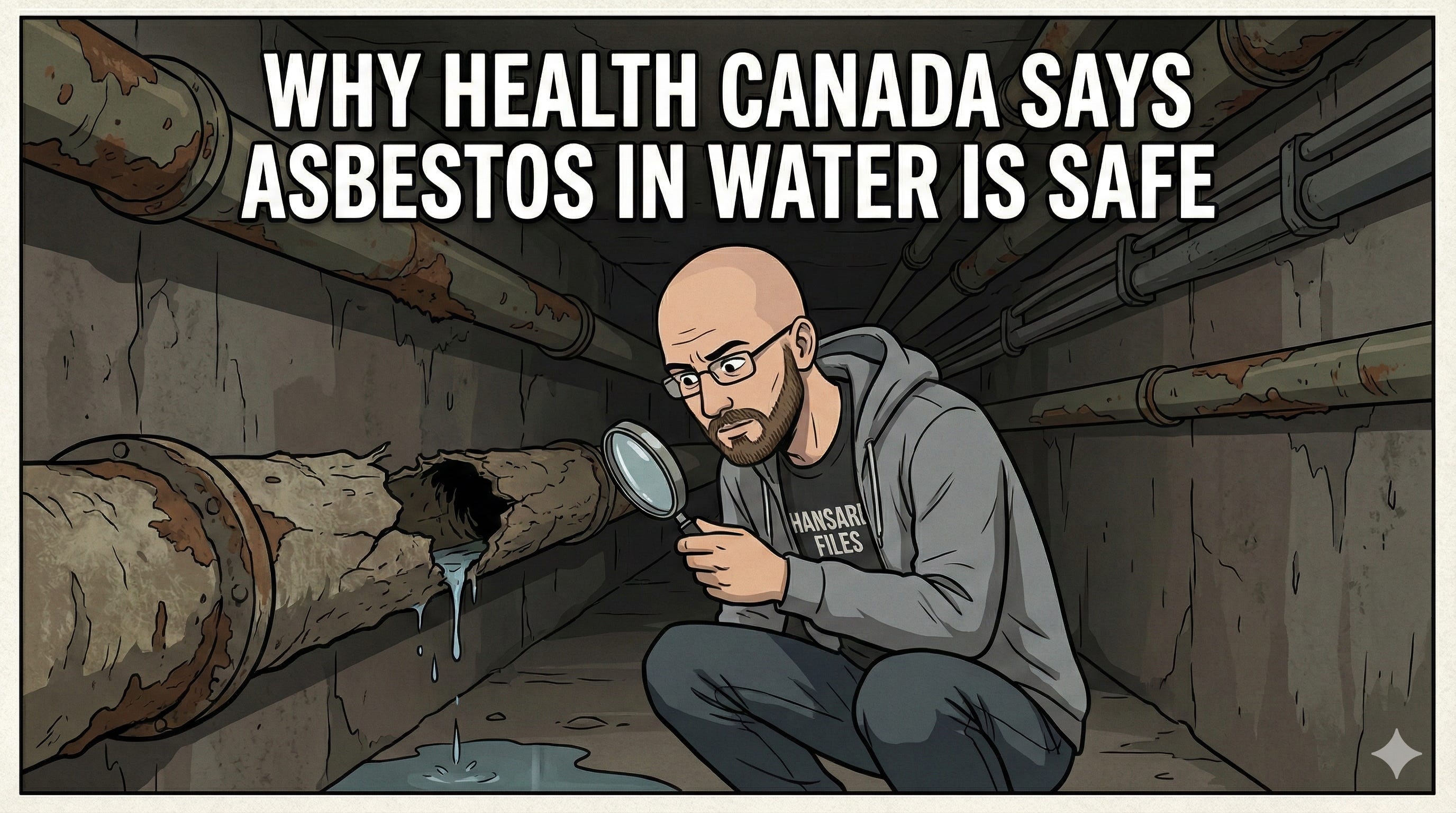
The most unsettling threats to public safety are often the ones that cannot be seen, tasted, or smelled. On a quiet Saturday in Ottawa, the federal government released a document that forces Canadians to confront what lies beneath their streets. The issue is asbestos in drinking water, a phrase that seems to contradict modern safety standards yet remains a physical reality in aging municipal infrastructure. While the substance is universally feared as a carcinogen when inhaled, the Department of Health has opened a consultation period for a draft document that navigates the complex, often counter-intuitive science of ingesting those same fibers.
This draft guidance arrives as cities across the nation grapple with the legacy of the mid-20th century construction boom. Between the 1940s and the late 1970s, asbestos-cement pipes were a standard choice for water mains. Now, decades later, those pipes are reaching the end of their useful life. As they corrode and deteriorate, they threaten to release fibers directly into the water supply. The government’s new publication acts as both a scientific assessment and a warning signal to water utility operators: the infrastructure is failing, and the particles are loose.
The Invisible Decay of Distribution Systems
The draft document released by the Department of Health presents a challenging paradox for the public. Despite the known dangers of asbestos in the air, the government is not recommending a maximum acceptable concentration for asbestos in drinking water. The scientific rationale is that current data does not provide consistent or convincing evidence that oral exposure causes adverse effects in humans or animals. This distinction between breathing the fiber and drinking it forms the core of the government’s regulatory stance.
However, the absence of a legal limit does not imply an absence of risk or concern. The text explicitly acknowledges that asbestos fibers can enter the water supply through the erosion of natural deposits or, more pressingly, the disintegration of aging cement pipes. These fibers do not dissolve. They do not evaporate. They remain suspended in the water column, invisible to the naked eye.
The guidance recommends that water utilities implement good practices to minimize the concentration of these fibers. This is less about immediate toxicity and more about the holistic health of the water distribution system. The presence of asbestos is a symptom of a larger mechanical failure. As the pipe material erodes, the structural integrity of the water main collapses, leading to potential pipe failures and major service disruptions. The federal government is urging municipalities to monitor for asbestos not just for health data, but as a diagnostic tool to determine which parts of the grid are on the verge of crumbling.
The Billion Dollar Economic Firewall
While Health Canada manages the physical pipes, the Department of Industry is recalibrating the economic filters that protect the nation’s corporate assets. In a separate notice, the government updated the thresholds for reviewing foreign investments, establishing the financial lines in the sand for 2026. These numbers dictate when a foreign takeover triggers a mandatory government review to determine if the deal provides a “net benefit” to Canada.
The new threshold for private investors from World Trade Organization member states has been set at $1.452 billion. For investors from countries with specific trade agreements, that ceiling is even higher at $2.179 billion. These figures represent the massive scale of capital flowing across borders, but there is a notable exception that highlights Ottawa’s shifting geopolitical anxieties.
For state-owned enterprises—companies owned or controlled by foreign governments—the review threshold is significantly lower, set at just $578 million. This sharply reduced limit signals a continued wariness regarding foreign government influence in the Canadian economy. It creates a tighter screen for acquisitions that could ostensibly serve political interests rather than purely commercial ones, effectively thickening the regulatory wall around Canada’s strategic sectors.
Trade Wars and Industrial Injury
Beyond the high-level policy of investment reviews, the federal ledger also chronicles the granular, brutal battles of international trade. The Canada Border Services Agency (CBSA) and the Canadian International Trade Tribunal (CITT) are currently locked in multiple investigations regarding the “dumping” of foreign goods—a predatory practice where products are sold below cost to destroy domestic competition.
One active front involves truck bodies imported from China. The investigation has proven so complex, involving a variety of goods and difficult evidentiary hurdles, that the CBSA has extended the preliminary phase of its inquiry to 135 days. A decision on whether to impose duties is now expected by early March. This delay underscores the difficulty of untangling modern supply chains to prove economic injury.
Simultaneously, the CITT has handed down a mixed verdict on steel strapping, a crucial industrial material. The Tribunal found that while imports from South Korea and Vietnam were negligible, dumped goods from Turkey and China have caused “material injury” to Canadian industry. This legal determination validates the complaints of domestic manufacturers who argue they are being undercut by unfair global trade practices. It sets the stage for punitive duties designed to level the playing field, protecting Canadian factories from being priced out of existence by subsidized foreign competitors.
The Northern Energy Link
In the energy sector, the focus turns to a long-term commitment on the Pacific coast. The British Columbia Hydro and Power Authority has applied for a thirty-year license to export electricity to Hyder, Alaska. This application is not merely a short-term transaction but a generational pact, seeking authorization to supply power from April 2026 through to March 2056.
The proposal involves exporting up to 3,000 kilowatts of power annually. While the raw numbers are modest compared to major industrial interties, the duration of the agreement speaks to the critical nature of cross-border infrastructure in remote regions. The Canada Energy Regulator is now soliciting public feedback on this “border accommodation transfer,” testing whether domestic needs are fully met before locking in a three-decade obligation to support the Alaskan grid.
Finality for Charities
The mechanisms of government oversight also extend to the revocation of status for organizations that fail to meet legal standards. The Canada Revenue Agency issued notices of intention to revoke the charitable registration of the Tegemeza (Support) Society and the Revelation Foundation.
These revocations are the final step in a rigorous audit process. Failure to comply with the Income Tax Act results in the “death penalty” for a charity—the loss of its ability to issue tax receipts, which effectively cuts off its fundraising lifeline. The publication of these names in the Gazette serves as the official public record of their dissolution, a stark reminder of the compliance burden carried by the non-profit sector.
A Nation Under Repair
The disparate notices published this Saturday converge on a single theme: maintenance. Whether it is the physical maintenance of eroding asbestos-cement pipes, the economic maintenance of fair trade practices, or the regulatory maintenance of charitable status, the federal government is engaged in a constant process of patching, reinforcing, and monitoring the systems that keep the country functional.
The consultation on asbestos in drinking water stands out as the most visceral of these updates. It requires citizens to accept a complex scientific reality—that a substance dangerous to breathe may be benign to drink—while simultaneously acknowledging that the infrastructure delivering their water is slowly turning to dust. As the comment period opens, it invites a national conversation about the hidden costs of the past and the price of safety in the future.
Source Documents
Canada Border Services Agency. (2026, January 24). Notice with respect to Truck bodies. Canada Gazette, Part I, 160(4).
Canada Energy Regulator. (2026, January 24). Application to export electricity to the United States: British Columbia Hydro and Power Authority. Canada Gazette, Part I, 160(4).
Canada Revenue Agency. (2026, January 24). Revocation of registration of a charity. Canada Gazette, Part I, 160(4).
Canadian International Trade Tribunal. (2026, January 24). Inquiry NQ-2025-005 Notice of Findings: Steel strapping. Canada Gazette, Part I, 160(4).
Department of Health. (2026, January 24). Draft Guidance on Asbestos in Drinking Water. Canada Gazette, Part I, 160(4).
Department of Industry. (2026, January 24). Investment Canada Act: Amounts for the year 2026. Canada Gazette, Part I, 160(4).
Thank you, Hansard, for this update on various subjects. It is heartening to see CBSA and CITT investigating trade concerns. Cheap imported steel could have negative effects on Canadian steel fabricators and any risk of these imports redirected in any way towards the US would exacerbate the current poor trade and political climate currently.
On the matter of asbestos in water supply systems, Mr. Google told me that there is a minimal risk of asbestos absorption into the body. Undoubtedly little research on absorption by certain body systems and cancer has been undertaken if I inferred correctly.
The unfunded liability of replacement of these water distribution systems and other deteriorating infrastructure will definitely haunt us in future.
Well that makes my skin crawl... yikers!!