


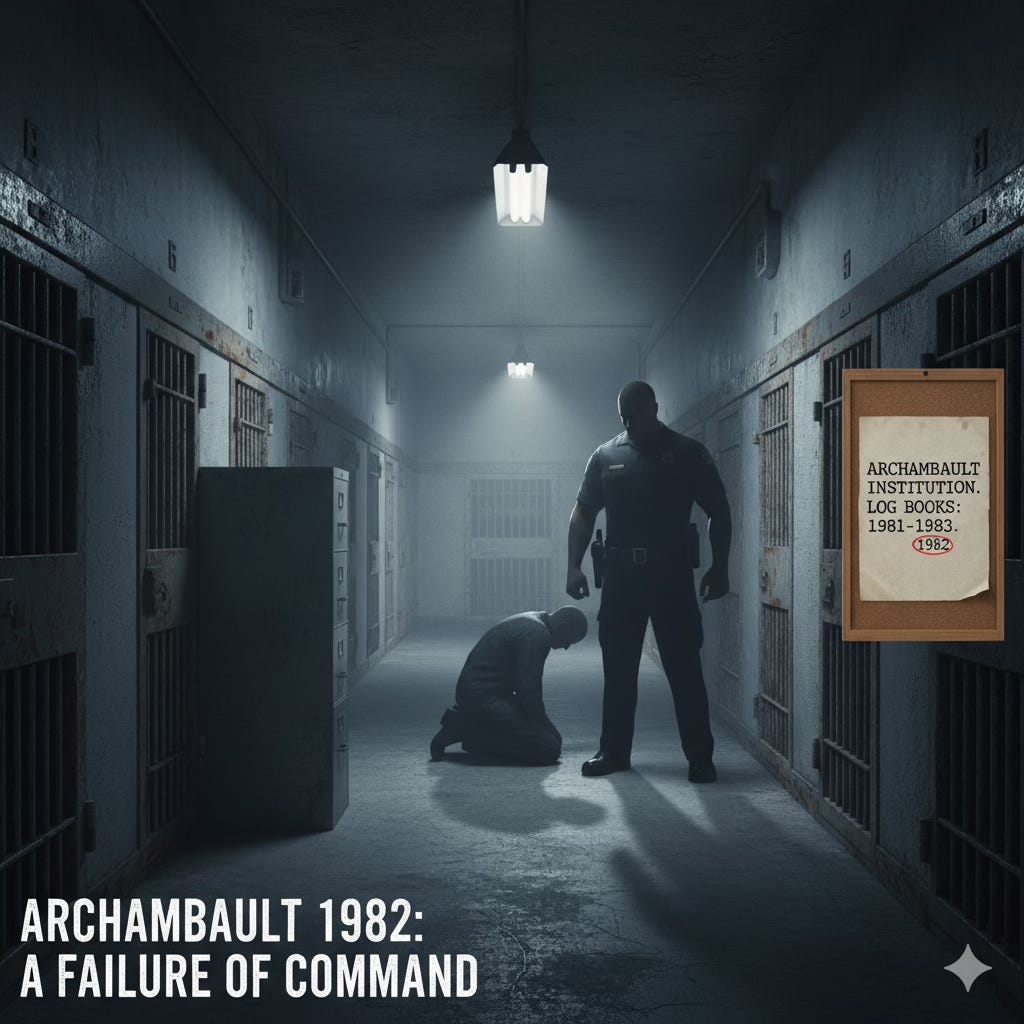
In 1984, Canada’s Correctional Investigator, R.L. Stewart, released a report examining one of the darkest chapters in Canadian penal history. The investigation was not about the infamous Archambault Institution riot of July 25, 1982, itself. That event’s brutality was already known: a riot that left three correctional officers murdered by inmates, two inmates dead by suicide, and five other officers injured.
Stewart’s mandate was to investigate what happened next.
The Solicitor General of Canada had received a flood of allegations describing a campaign of “mistreatment of several inmates” in the riot’s aftermath, particularly those transferred to the segregation unit. The resulting report is a clinical dissection of systemic failure, detailing how, in the shadow of profound tragedy, a parallel system of abuse was allowed to fester, undocumented and unchecked.
Missing Evidence, Competing Truths
From the outset, the investigation was compromised by two major hurdles: missing evidence and coordinated misinformation.
The Vanishing Log Books
The single most critical failure of accountability was the disappearance of the institution’s primary records. The Detention Log Books from April 1981 to December 1982 and the Daily Detention Reports from June 1982 to January 1983 were both missing.
What does this mean in practice? These logs were the only official records detailing who entered the detention unit, when they entered, and for what purpose. Without them, investigators had no definitive way to place specific guards in the unit at the time of alleged incidents.
The report notes these documents were kept in unlocked filing cabinets, accessible to staff. The Investigator concluded: “the coincidental disappearance of the only institutional records which would have established the presence of institutional staff in the detention unit... suggests that their disappearance was not altogether inadvertent”.
A Conspiracy to Fabricate
The investigation was further complicated by the inmates themselves. The report details evidence of an agreement among inmates to “fabricate or at least exaggerate allegations of mistreatment”.
This conspiracy, according to the testimony of two inmates, was formed to draw public attention and alleviate their fears. One inmate who had previously made serious allegations—including inventing the “wet towel treatment” allegation—recanted his entire testimony, stating it was all fabricated. The report identified 16 inmates involved in this conspiracy, who together accounted for nearly 88% of all allegations made during the investigation.
The Corroborated Abuse
Despite the missing logs and the inmate conspiracy, the Investigator found conclusive evidence that mistreatment didoccur. The investigation pieced together corroboration from other sources: medical staff, classification officers, and lawyers.
Gas, Kneeling, and Physical Force
While guards categorically denied using gas, multiple Health Care Officers and a CX-6 officer testified they “noticed the smell of gas in detention on two or three occasions” in August 1982. On one occasion, guards told a nurse that inmates had been gassed for failing to obey orders. The report concludes gas was used, and that the required post-gassing medical procedures were not followed.
More directly, the report confirmed one specific case of “humiliating treatment”. A guard (name redacted) admitted to forcing an inmate (name redacted) to kneel on two separate occasions, once in front of classification officers, and forcing him to “make humiliating statements”.
In other cases, physical corroboration was strong.
One inmate alleged being severely beaten during an escort. His lawyers later testified they observed his injuries, including a cut on his face and bruises on his legs and arms. The report concludes this inmate was, in fact, physically mistreated.
Another inmate alleged abuse in the detention yard. His lawyer observed bruising on the inmate’s throat and redness on his face, and his family later observed scratches on his legs. The report concludes this inmate “did suffer physical mistreatment”.
A Campaign of Harassment
Beyond specific violence, the Investigator found credible evidence of systemic harassment and the denial of basic rights, which violated the Penitentiary Service Regulations.
Food: The report found it “very likely” that guards refused to feed inmates or “intentionally thrown food into their cells”.
Sleep: It concludes inmates were prevented from sleeping by guards “banging on or kicking their cell door” and keeping fluorescent lights on all night.
Clothing and Bedding: It concludes that some inmates were “improperly denied” mattresses and bedding and “were probably not given any clothing,” leaving them naked in their cells for days.
A System in Chaos
How could this happen? The report paints a picture of an institution consumed by a desire for retribution, with a total collapse of oversight and procedure.
Motive and Opportunity
The report identifies a clear motive: the guards were in shock and mourning. The “sheer violence and destruction” of the riot created “bitterness, aggressiveness and animosity towards the inmates”. One guard testified, “I would have gone in there with a submachine gun”.
This motive was met with opportunity. The detention unit was isolated. More importantly, the institution’s guard assignment system was in chaos. Staff absenteeism was high, and the formal duty rosters were not being followed. Officers at the CX-6 or CX-8 level testified that re-assignments were noted “on bits of paper... and then discarded”. This breakdown “provided a significant opportunity for guards to enter the detention unit during the day shift without any authority to do so”.
A Breakdown in Command
Senior management was aware of “general complaints” and “rumours” of mistreatment from the Inmate Committee, lawyers, and inmates’ families. The Assistant Warden of Socialization, Michel Gilbert, admitted to investigators, “The inmates probably had a rough time in the hole... They were probably badly harassed”.
Despite this knowledge, the response from the Warden and his deputies was deemed “too late” and insufficient. They increased the frequency of rounds, but the report notes this was ineffective, as no mistreatment would occur in their presence. No senior officer was posted inside the unit to maintain control.
The Failure of Health Care
The institution’s Health Care Unit, which should have been the inmates’ last line of defense, failed completely.
The required daily visit by a Health Care Officer to each inmate in segregation did not happen.
Most Health Care Officers were “ignorant of these requirements”.
When examinations did occur, they were often conducted through the food slot or peep hole of the cell door, in the presence of several guards. This made “any private consultation... virtually impossible”.
The Data Brief
The Event: Following a 1982 riot where three guards were murdered, Archambault Institution staff were investigated for allegations of retaliatory abuse against inmates.
The Problem: The investigation was severely hampered by two factors: the “not altogether inadvertent” disappearance of all key detention logs and evidence of a conspiracy among 16 inmates to fabricate or exaggerate allegations.
The Findings: Despite these challenges, the Investigator found conclusive proof of mistreatment. This included the confirmed use of gas, an admitted incident of “humiliating treatment” by a guard, and multiple inmate injuries (cuts, bruises) corroborated by lawyers.
The Cause: The report concludes this abuse was enabled by a total systemic failure. Staff had a clear motive (retaliation). The guard assignment system was in chaos, destroying accountability. Senior management knew of “rumours” but failed to act effectively. The Health Care Unit failed to perform its oversight duties, conducting exams through food slots while guards were present.
The Conclusion: The institution failed to account for the actions of its staff, leaving a cloud of suspicion that its own records and procedures were incapable of refuting.
The Lingering Question
The 1984 Archambault report is not simply a story of “a few bad apples.” It is an anatomy of a systemic breakdown, where tragedy was compounded by a failure of professionalism, oversight, and courage.
The most disturbing question is not whether every allegation of abuse was true. The Investigator’s core finding is that the institution, through its own negligence, created an environment where such abuse could happen and, worse, left no reliable records to prove it didn’t. The report concludes that the administration, having failed to properly account for the actions of its staff, “failed to rebut any of these allegations”. The missing log books remain a silent, damning testament to a failure of command from which the Correctional Service could not, and should not, look away.
Source Documents
Stewart, R.L. (1984, June 21). Report on allegations of mistreatment of inmates at Archambault Institution following the events which occurred on July 25th, 1982. Correctional Investigator Canada.