

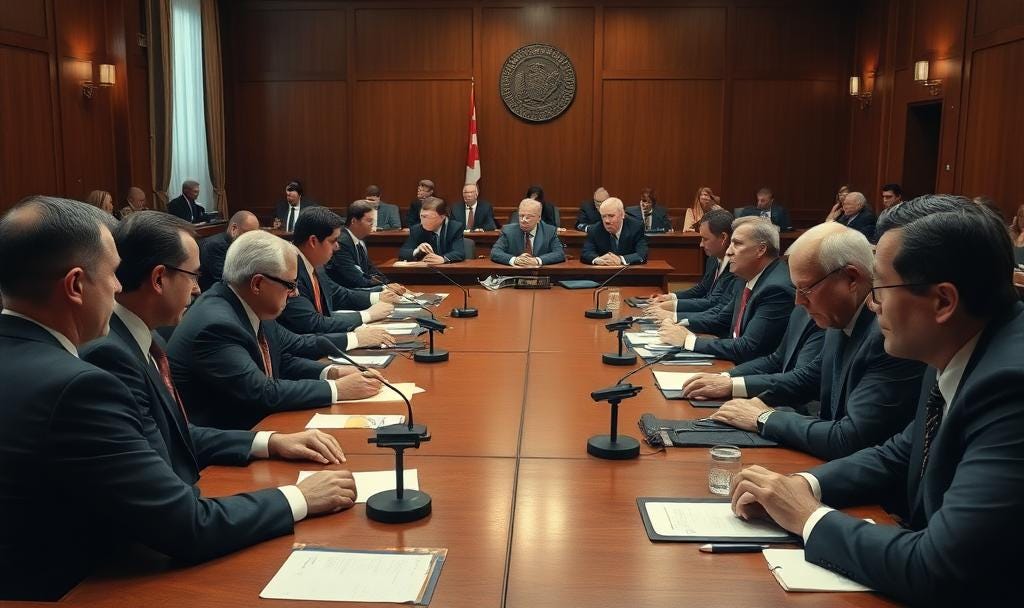
If you picture Canadian Parliament, you probably imagine one of two things: the cavernous House of Commons chamber where MPs read sleepy speeches to an empty room, or the theatrical chaos of Question Period, with insults and accusations hurled across the aisle.
For the most part, you’d be right. But the real, granular work of government—the messy, often unglamorous process of holding power to account—happens somewhere else. It happens in small, functional committee rooms, where a handful of MPs gather to dissect issues, hear from witnesses, and fight over the fine print of the nation’s business.
On July 7, 2025, one such meeting of the Standing Committee on Transport, Infrastructure and Communities provided a masterclass in how this system works. The topic was a controversial billion-dollar loan for ferries, but the proceedings themselves revealed the levers, rules, and raw-knuckle politics that underpin our entire democracy.
By the end of this article, you won't just understand the controversy over the BC Ferries deal; you'll understand the tools MPs use to fight, negotiate, and ultimately hold a government's feet to the fire. We're going to dissect this meeting, moment by moment.
The Fight Before the Fight
The meeting began with a simple, almost comical, problem. The Chair, Liberal MP Peter Schiefke, tried to call the meeting to order, but before he could even finish his opening remarks, he was interrupted. Two members on Zoom had their virtual hands raised, and a dispute erupted over who was first.
Chair: "I had Mr. Kelloway first with his hand up."
Philip Lawrence (CPC): "Zoom recognizes left to right. Mr. Albas was first, so by rule, you have to recognize him first."
Mike Kelloway (Lib.): "I didn't touch a bloody thing on my computer."
This wasn't just a squabble over etiquette. In committee, the person who speaks first gets to set the agenda by introducing the first motion. He who speaks first frames the entire debate. The opposition, having requested this emergency meeting, was adamant that they should lead.
The argument escalated until the Chair, relying on the clerk's list, prepared to give the floor to the Liberal MP. This prompted a rare and dramatic parliamentary move from the opposition.
Philip Lawrence (CPC): "I would challenge the chair."
A "challenge of the chair" is a vote of no-confidence in the person running the meeting. It’s non-debatable and immediately forces a vote on whether the chair’s ruling should stand. The result was a stunning rebuke: the chair's decision was overturned, 5-4. The opposition had won the first battle.
The Motion on the Table: What Was This All About?
So what was so important that it caused this procedural brawl? After winning the floor, Conservative MP Dan Albas laid out his motion. The committee, he demanded, must urgently study why the Canada Infrastructure Bank (CIB) gave a $1 billion loan to BC Ferries to buy ships from a Chinese state-owned shipyard.
The core of the issue was a glaring contradiction. The opposition pointed out that while the government was publicly wringing its hands over American steel tariffs and talking about being "Canada strong," a federal Crown corporation was actively financing the outsourcing of Canadian shipbuilding and steel jobs to China.
The motion had three key demands:
Urgently launch a study of the decision.
Call the Minister of Transport, the Minister of Infrastructure, the CEO of the CIB, and the CEO of BC Ferries to testify for one hour each.
Immediately after the testimony, force a one-hour debate and vote on a motion to make recommendations.
This last point was the most aggressive. The opposition didn't just want to ask questions; they wanted to condemn the government's actions immediately, on the same day, while the issue was hot.
The Art of the Amendment: Watering Down the Attack
The government and Bloc Québécois members knew they couldn't stop the study—the opposition had the votes. So they tried to change the terms of the debate through amendments. Think of this as parliamentary negotiation: "I agree with your idea, but I want to change the ending."
First, Liberal MP Mike Kelloway proposed an amendment to delete that aggressive third point entirely. His argument was one of process: the committee shouldn't "presuppose witness testimony" or "guillotine" debate. Let the experts testify, he argued, and let the committee analysts write a proper report later. The opposition saw this as a classic delay tactic. "He wants to push any timely recommendations as far back as possible," MP Albas countered, so the "story die over the summer".
The Liberal amendment failed, 5-4.
Next came the Bloc Québécois. MP Xavier Barsalou-Duval proposed a clever compromise. He moved an amendment to replace the opposition's aggressive final paragraph with something softer. Instead of forcing a vote on a pre-determined opposition motion, his amendment simply set aside one hour after the testimony for the committee "to determining the action it intends to take" .
This gave the committee more flexibility. It kept the pressure on by locking in time for a decision, but it didn't pre-suppose the outcome. It was a consensus-builder, and it worked. The amendment passed unanimously, 9-0.
What This Means and What Happens Next
After all the procedural maneuvering, the final, amended motion also passed unanimously.
What you just witnessed wasn't just squabbling; it was the machinery of parliamentary oversight in action, grinding away. The opposition used the rules to force an emergency meeting. They used a rare challenge to seize control of the agenda. They put forward an aggressive motion to force testimony and an immediate conclusion. And through a process of amendment and negotiation, the committee found a compromise that all parties could agree to.
The outcome is concrete: within 30 days, two cabinet ministers and two CEOs will have to appear before the committee and answer for this billion-dollar decision. The opposition successfully used the forum to force powerful people to answer public questions they would rather avoid.
This is the messy, complicated, and essential process of democracy. It’s not always pretty, but it’s how accountability is forged—one point of order, one amendment, and one tense vote at a time.