


Can we tap into the planet's immense natural furnace for clean, reliable energy without shaking the ground beneath our feet? It's a critical question in the race to net-zero. While some energy projects have been linked to human-caused earthquakes, a recent two-year study of a pioneering geothermal project in Alberta suggests a safer path forward may be possible. This isn't just about rocks and energy; it's about building a sustainable future for Canada, safely.
The Challenge: Energy's Unwanted Side Effect
For years, parts of Western Canada have experienced "induced seismicity." It's a technical term for something simple: small, human-caused earthquakes. These tremors can be triggered by resource development activities that change pressures deep underground, like hydraulic fracturing or wastewater disposal.
This has created a major challenge for new energy technologies, including geothermal. Geothermal energy works by harnessing the Earth's natural heat. Conventional geothermal systems often involve pumping fluid into and out of underground reservoirs to collect this heat. While effective, this process can sometimes alter subsurface pressures and trigger the same kind of small earthquakes we're trying to avoid.
So, how can we get the clean heat without the risk? A company in Alberta thinks they have the answer.
A New Idea: The "Radiator Under the Earth"
Enter Eavor Technologies Inc. and their project, Eavor-Lite™, in Clearwater County, Alberta. They are testing a different kind of geothermal system, known as an Advanced Geothermal System (AGS).
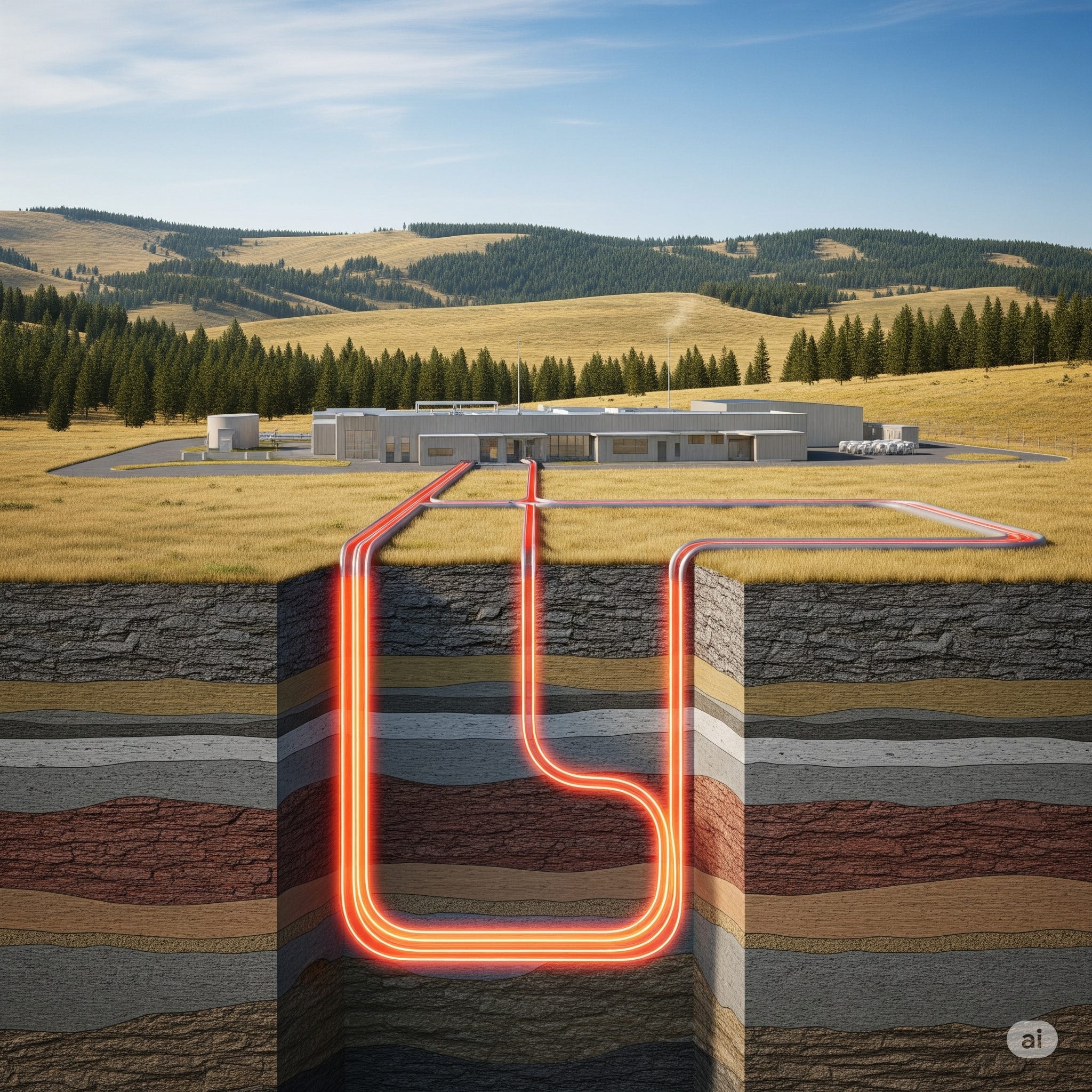
Think of it like a giant, sealed radiator buried deep underground. Here’s how it works:
Fluid is sent down one well, where it travels through a vast, closed network of horizontal pipes.
As it flows through this loop, it absorbs heat from the surrounding rock through simple conduction, just like a pot of water on a stove.
The heated fluid then naturally rises up a second well, where the energy is extracted at the surface.
The key difference is that the fluid never leaves the pipes. It doesn't get injected into the surrounding rock, so in principle, it shouldn't change the pressures that could lead to earthquakes. But a critical question remained: could the long-term cooling of the rock around the pipes cause stress changes and trigger seismicity on its own?. To find out, scientists started listening very, very closely.
The Experiment: Listening for a Whisper
From November 2020 to November 2022, a team from the University of Calgary and the Geological Survey of Canada set up an advanced seismic monitoring network to watch the Eavor-Lite™ project.
They installed four highly sensitive broadband seismometers, forming a dedicated "EVR array," within 10 kilometres of the site. These acted like a set of powerful microphones, tuned to hear even the faintest rumbles from deep within the Earth. This local array was combined with data from 10 other public seismic stations across the region to create a comprehensive picture of all seismic activity.
Using a sophisticated machine-learning workflow, the researchers sifted through two full years of continuous data, hunting for any sign of seismic events.
Did You Know? The study area in central Alberta is not seismically silent. The Alberta Energy Regulator has a "traffic light" system in place for some industrial activities, where operations must slow down or stop if seismic events reach a certain magnitude. This means the region is known to have seismogenic potential, making the Eavor-Lite™ results even more significant.
The Verdict: Two Years of Silence
After analyzing all the data, the results were clear and powerful.
Over the two-year period, the network detected 94 seismic events in the broader region of west-central Alberta. These included:
Known quarry blasts.
Naturally occurring earthquakes, like a magnitude 3.66 event near Banff.
A cluster of tremors in the well-documented Rocky Mountain House Seismogenic Zone.
But within the crucial area around the geothermal plant, the instruments heard nothing. The study found zero detectable seismic events within a 25-kilometre radius of the Eavor-Lite™ closed-loop system.
The researchers concluded with a "high level of confidence that no events with ML>1 were induced by operations during the two-year monitoring period". In simple terms, the geothermal radiator worked as designed, providing heat without causing any detectable earthquakes.
Conclusion
This study is a significant piece of the clean energy puzzle. It provides the first direct, long-term evidence that closed-loop geothermal systems can operate safely in a region with known seismic potential. While this is just one project, the results from Eavor-Lite™ demonstrate that with the right technology and careful monitoring, we can develop new, clean energy sources responsibly.
For Canadians, this is promising news. It suggests a future where our energy can be clean, reliable, and, importantly, safe. Staying informed about studies like this is key to understanding the real-world progress being made toward a sustainable Canada.
Source: Rojas-Parra, J., Marion, K.P., Salvage, R.O., and Eaton, D.W. (2025). Enhanced seismicity monitoring in central Alberta, Canada: 2020-2022. Geological Survey of Canada, Open File 9241, 1 .zip file. https://doi.org/10.4095/pps3fqydpq