


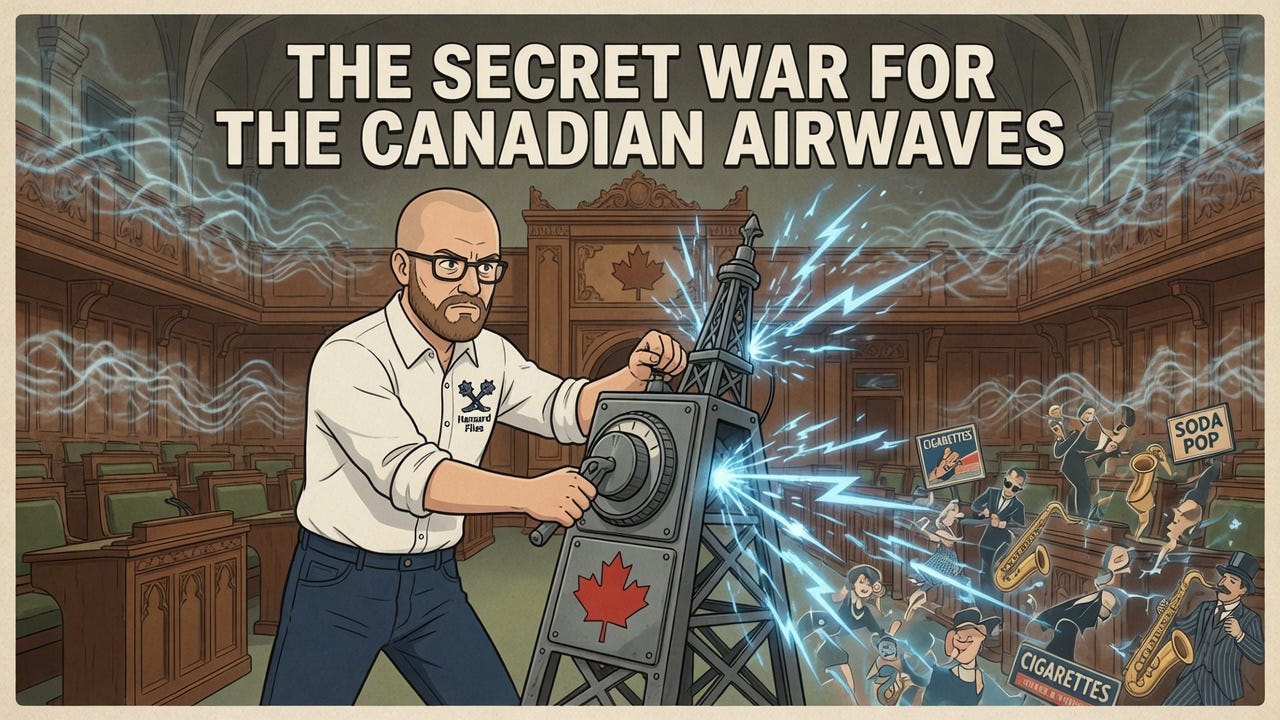
It was a silent invasion, launched not by soldiers, but by invisible waves drifting across the border. In the winter of 1929, the greatest threat to Canadian radio sovereignty wasn’t a foreign army; it was the unchecked chaos of the electromagnetic spectrum. Families from Halifax to Vancouver gathered around their crystal sets, tuning in for news and entertainment, only to be bombarded by a cacophony of American vaudeville, Chicago jazz, and New York advertisements. The Dominion’s own voice was being drowned out in the ether, fractured into weak, local signals that could barely penetrate the static.
This was the crisis that launched the Aird Commission. At stake was nothing less than the cultural survival of the nation. Without a radical intervention, the government feared that a generation of Canadian children would grow up “moulded to ideals and opinions that are not Canadian”. The solution they proposed was a daring act of nationalization that would forever define the country’s media landscape.
The Chaos of the Ether
To understand the panic in Ottawa, one must understand the “broadcasting situation” of the late 1920s. Radio was the Wild West. It was a “foster child” of the Department of Marine, regulated by the Radiotelegraph Act—a piece of legislation designed for ship-to-shore Morse code, not mass media.
Private enterprise had stepped into the void, but the results were messy. Stations were crowded into urban centers, leaving the vast rural north in silence. Worse, because there was no public funding, station owners were forced to rely on “direct advertising” to survive. The listener’s experience was a constant barrage of sales pitches extolling the merits of soap and patent medicines.
The Royal Commission on Radio Broadcasting, chaired by Sir John Aird, President of the Canadian Bank of Commerce, was given a mandate to fix this broken system. Alongside him were Charles Bowman, editor of the Citizen, and Dr. Augustin Frigon, a technical director from Montreal. Their mission was to travel the world and find a way to secure Canadian radio sovereignty before it was too late.
A Global Hunt for Control
The commissioners did not content themselves with hearing complaints in Ottawa. They embarked on a global reconnaissance mission, visiting London, Berlin, Paris, Geneva, and New York to study how other nations managed the “ether”.
What they found in Europe shocked them—in a good way. In Great Britain, they saw the British Broadcasting Corporation (BBC) operating as a public service, free from the commercial pressures that plagued North America. In Germany, they witnessed a system of state ownership that treated radio as a tool for national unity.
The contrast with New York was stark. The American model, observed at the National Broadcasting Company (NBC), was built on profit and mass appeal. The commissioners returned to Canada with a conviction that the “destiny of Canada” depended on rejecting the American commercial model in favor of a system backed by the “national power and prestige of the whole public”.
The Radical Blueprint for Sovereignty
On September 11, 1929, the Commission dropped a bombshell report that would serve as the Magna Carta of Canadian broadcasting. They concluded that the interests of the nation could only be served by “public ownership, operation and control”.
Their proposed structure was aggressive. They recommended the creation of a “Canadian Radio Broadcasting Company” (C.R.B.C.), a public utility vested with the full powers of private enterprise but dedicated solely to the public good. This wasn’t just a regulatory body; it was a monopoly.
To physically occupy the airwaves and push back American signals, they proposed the construction of seven high-power stations, each blasting 50,000 watts. These electronic fortresses would be spaced across the continent to ensure that every settled region could receive a clear Canadian signal on a standard five-tube set.
The Three Dollar Price of Independence
Sovereignty, however, came with a price tag. The Commission estimated the capital cost of these high-power stations at $3,000,000, with an annual operating budget of $2,500,000. In 1929, these were astronomical sums.
To pay for it, Aird and his colleagues proposed a controversial funding model:
A License Fee: Every household with a radio would pay $3.00 per year (up from the existing $1.00 fee).
Indirect Advertising Only: “Direct advertising”—the hard sell—would be banned entirely. Sponsors could only use “indirect advertising,” where a firm could sponsor a program but was forbidden from extolling their merchandise on air.
Government Subsidy: Recognizing that Canada had a “relatively small population scattered over a vast tract of country,” the Commission admitted that license fees alone wouldn’t suffice. They requested a $1,000,000 annual subsidy from the Dominion Government.
A Unanimous Verdict
The report was unanimous. The commissioners had heard from 164 witnesses in 25 cities, and the verdict was clear: “Canadian radio listeners want Canadian broadcasting”. They viewed radio not as a business, but as a “great force in fostering a national spirit”.
The Aird Report laid the philosophical groundwork for the cultural institutions that define Canada today. It argued that the airwaves were a public resource, not a private goldmine. By recommending a system where the state controlled the infrastructure but provinces controlled the programming, they attempted to balance national unity with regional identity.
In the end, the Aird Commission was a declaration of independence. It asserted that to be a nation, Canada needed more than just a border; it needed a voice.
Our team digs through thousands of pages of forgotten royal commissions and dusty archives to bring you the stories that shaped the nation. Subscribe today to help us keep the history files open.
Source Documents
Royal Commission on Radio Broadcasting. (1929). Report of the Royal Commission on Radio Broadcasting.
That was then, this is now.
I look at https://www.parl.ca/legisinfo/en/bill/37-2/c-11 , https://www.parl.ca/legisinfo/en/bill/44-1/c-11 and parts of https://www.parl.ca/legisinfo/en/bill/41-1/C-11 I see a government that wanted to protect incumbent corporations (primarily US based, but that didn't seem to matter) over Canadian innovation for communicating with Canadians.
What we ended up with is streaming services dominated either by US brands, or Canadian incumbents that exist only because of government granted exclusivity and not because they provide an actual public service.
-------------
I even see the CBC as not representing Canadians, but representing the Dominion of Canada institutions in ways that are unhelpful for maintaining the union. Their style of propaganda regularly generates alienation, and not only from the subordinate peripheries that was created by Canada's Northward and Westward expansion post-1867. This far too regularly gets confused with a partisan bias, given many of the current partisan brands grew out of that alienation (Reform from the west that took over the Conservative party, CCF/NDP from the west, and the Bloc Quebecois trying to recreate Lower Canada -- regularly mistaking northward expansion of the Canadian empire as part of an expansion of their French empire loyalists https://ecwpress.com/products/never-without-consent ).
A great post to start my day. Your historical piece reminded me of my early journey of discovering the World Wide Web in the early nineties. Thanks Glen. Well written, timely, and an enjoyable read. M.