


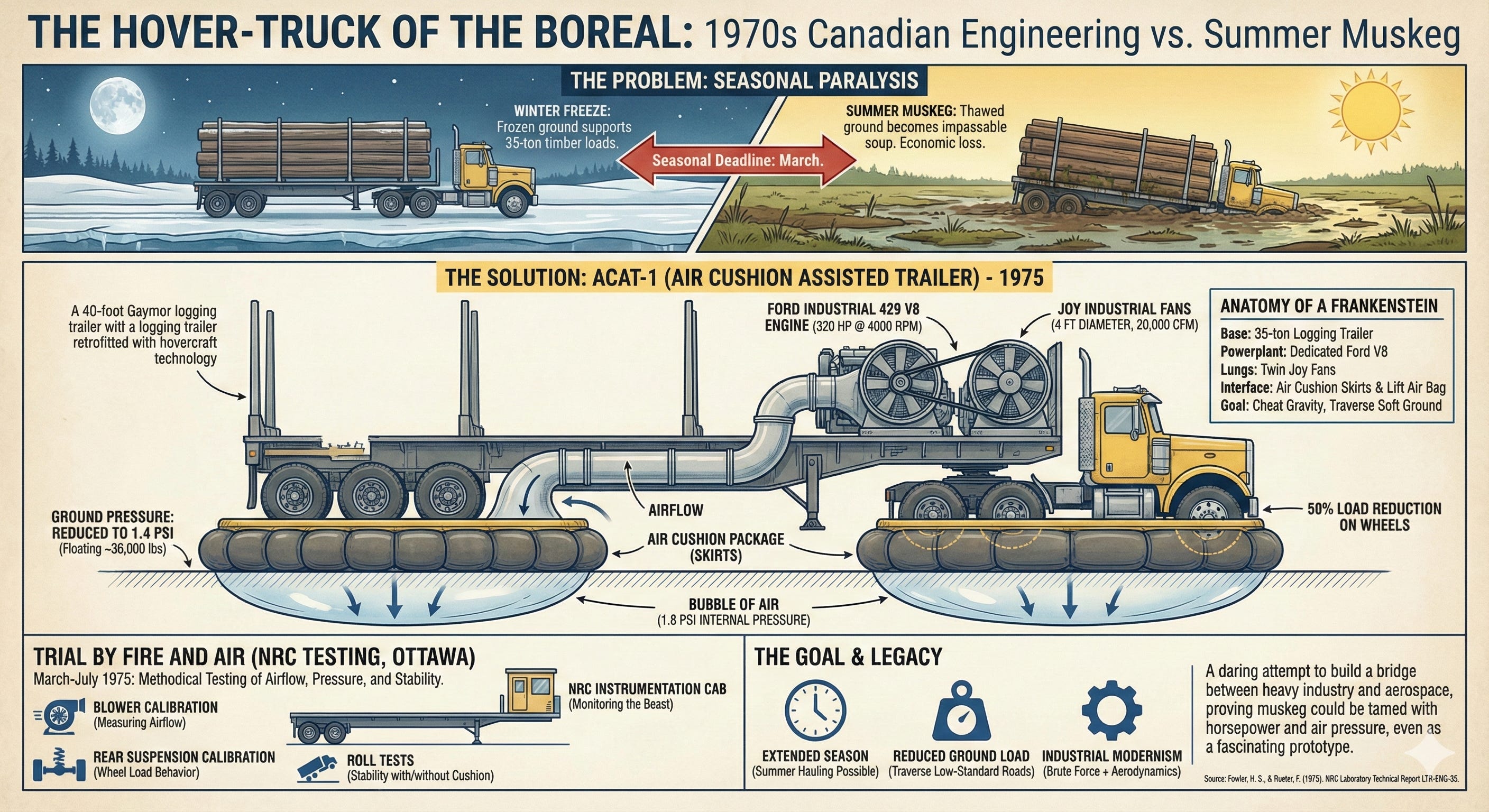
March in the Canadian boreal forest is a deadline. It is the moment when the geography turns against the economy. For the logging industry of the mid-1970s, the winter freeze was the only infrastructure that mattered. When the ground was frozen hard as iron, massive semi-trailers could haul thirty-five tons of timber from the deep bush to the main haul roads. But as the March sun warmed the shield, the ice roads turned into an impassable soup of muskeg and mud. A standard logging truck would not just get stuck; it would sink.
For decades, this seasonal paralysis cost the Canadian economy millions. The solution, proposed in a flurry of technical optimism in 1975, was not to build better roads, but to build a truck that didn’t quite touch them.
In the spring of 1975, inside the Engine Laboratory of the National Research Council (NRC) in Ottawa, a strange hybrid beast was being prepared for trial. It was a standard Gaymor logging trailer fused with the technology of the future: a high-powered hovercraft system. Designated the ACAT-1, or Air Cushion Assisted Trailer, it represented a daring attempt to cheat gravity and conquer the soft ground of the Canadian summer.
The Multi-Million Dollar Mud Trap
The technical objectives laid out in the original Program for the Advancement of Industrial Technology (PAIT) contract were deceptively simple. The goal was to allow summer hauling of forest products in areas where roads lacked a substantial base. The boreal forest floor is unforgiving; without a deep gravel bed, heavy duty hauling is impossible unless the ground is frozen.
The ACAT-1 was designed to break this cycle. By retrofitting a trailer with an air cushion system, engineers believed they could reduce the load on the wheels by fifty percent. If the wheels only carried half the weight, the truck could traverse low-standard roads that would otherwise swallow it whole. The project was a collaboration of government ambition and private sector ingenuity, involving the Department of the Environment’s Logging Section, Gaymor Trailers Ltd., and Jones Kirwan & Associates, a firm that would eventually morph into HoverJak Ltd.
The specifications were precise and demanding. The vehicle had to haul a full trailer load out to main roads regardless of climatic conditions. It was a direct challenge to the seasons. The result was a forty-foot-long industrial experiment that looked less like a vehicle and more like a mobile factory floor.
Anatomy of a Frankenstein
To understand the ACAT-1 is to understand the brute force engineering of the 1970s. The base was a standard eight-foot-wide logging semi-trailer with a rated payload of thirty-five tons. It featured massive fourteen-inch I-beam main rails and a “Neway” tandem suspension system capable of handling 44,000 pounds. But strapped to the belly of this conventional hauler was a complex parasitic organism: the air cushion package.
The heart of the lift system was a Ford Industrial 429 cubic inch V8 engine, a powerplant capable of generating 320 horsepower at 4,000 RPM. This engine did not drive the wheels. Its sole purpose was to scream at high revolutions, driving two Joy Industrial fans, each four feet in diameter.
These fans were the lungs of the beast. Spinning at 2,000 RPM, they were designed to force 20,000 cubic feet of air per minute into a system of ducts running through the main frame of the semi-trailer. The air was channeled into “skirts”—multi-cell rubber and hyperlon fabric composites attached to the undercarriage.
The physics were a balancing act between pressure and containment. The fans pressurized the air within the skirts to approximately 1.8 pounds per square inch (psi). While this sounds low compared to the high pressure of a hydraulic line, across the vast surface area of the trailer’s footprint, it was enough to lift mountains. The system was designed to exert a ground pressure of only 1.4 psi, effectively floating nearly 36,000 pounds of the trailer’s weight on a bubble of air.
The Physics of Floating Heavy Iron
The engineering challenge was not just about generating lift; it was about distribution and control. The cushion system was split into two separate pallets, designed to stabilize the massive load. The original design specified a “compensator bag” area of 83 square feet and a cushion area of 70.5 square feet.
The system utilized a “lift air bag” that acted as a constant-pressure suspension spring. This was the critical interface between the rigid steel of the trailer and the undulating chaos of a logging road. The air bag transferred the lift from the cushion proper to the trailer frame, allowing the “lift air plenum”—the chamber holding the pressurized air—to rise and fall with the road contour. This setup was intended to minimize skirt wear, a constant concern when dragging fabric over rocks and stumps.
The engineers had outlined two distinct design cases. The first, Design Case II(a), involved operating on public roads with a gross weight of 76,000 pounds. In this configuration, the air cushion would take 35,700 pounds of the weight, leaving the wheels to manage the rest. The second, more ambitious Design Case II(b), involved fitting “sidebodies” or wings to the trailer, expanding its width to thirteen feet. This wide-stance configuration was intended for private roads and would allow a gross weight of 106,000 pounds, with the air cushion shouldering a massive 58,000 pounds.
However, even in the sterilized environment of the design phase, reality intruded. Mechanical difficulties in fitting the sidebodies forced the team to abandon the wide-stance configuration for the initial test program. They would have to prove the concept on the narrower, standard-width setup first.
Trial by Fire and Air
By March 1975, the National Research Council was ready to subject the ACAT-1 to a rigorous inquisition. The report, authored by H.S. Fowler and P. Rueter, outlined a methodical destruction of the unknown. They were not just kicking the tires; they were planning to measure the airflow, the pressure distribution, and the suspension geometry under extreme duress.
The test program was scheduled to run until July 1st, 1975. It began with the basics: blower calibration. Before the truck ever moved, the engineers needed to know exactly how much air the Ford V8 and Joy fans were actually moving versus what the calculations promised. Following this, they planned a “Rear Suspension Calibration” to understand how the standard wheels behaved when half their burden was suddenly removed by the air cushion.
The most nerve-wracking phase was the “Roll Tests.” A logging truck is already a vehicle with a high center of gravity, prone to tipping on uneven ground. The introduction of an air cushion—a dynamic, shifting support system—introduced terrifying new variables. The NRC planned to roll the vehicle without the air assist, and then again with the cushion active, to see if the “floating” trailer became unstable.
To conduct these tests, an “NRC Instrumentation Cab” was mounted directly onto the trailer deck. Inside this small box, an observer would sit amidst a tangle of wires and gauges, monitoring the heartbeat of the hover-system while the Ford engine roared just feet away.
The Weight of Innovation
The stakes of these trials were clarified by the load calculations. The lift engine, blower, ducting, and the observer’s cab added approximately 5,000 pounds of parasitic weight to the trailer. To simulate a real-world logging run, the engineers planned to add 15,000 pounds of disposable load, with its center of gravity positioned midway along the deck.
The definition of success was precise: “Design airlift is then defined as being that required to balance this load, and return the wheels of tractor and trailer to their unloaded condition.”
If successful, the ACAT-1 would prove that heavy industry did not need to wait for winter. It would demonstrate that with enough horsepower and air pressure, the Canadian muskeg could be tamed. The report from March 1975 captures a moment of high industrial modernism, where the solution to a muddy road was not gravel, but a hovercraft.
The legacy of the ACAT-1 lies in the details of its testing. It was a bridge between the brute force of the logging industry and the aerodynamics of the aerospace sector. Whether it would eventually revolutionize the industry or remain a fascinating prototype was yet to be determined on the test tracks of Ottawa, but the ambition remains a testament to the lengths engineers would go to keep the timber moving.
Source Documents
Fowler, H. S., & Rueter, F. (1975, March). Test on an air-cushion assisted trailer ACAT-1 introduction & test program [Laboratory Technical Report LTR-ENG-35]. National Research Council Canada.
During the 70s as a dispatcher of truckers delivering building materials to northern regions, the drivers returned with stories that supported the need for this ACAT-1.
Did it ever get built and used in any form? I remember reading in Pierre Berton's The Last Spike that entire pieces of equipment and parts of bridges were swallowed up by the muskeg of which you write.