


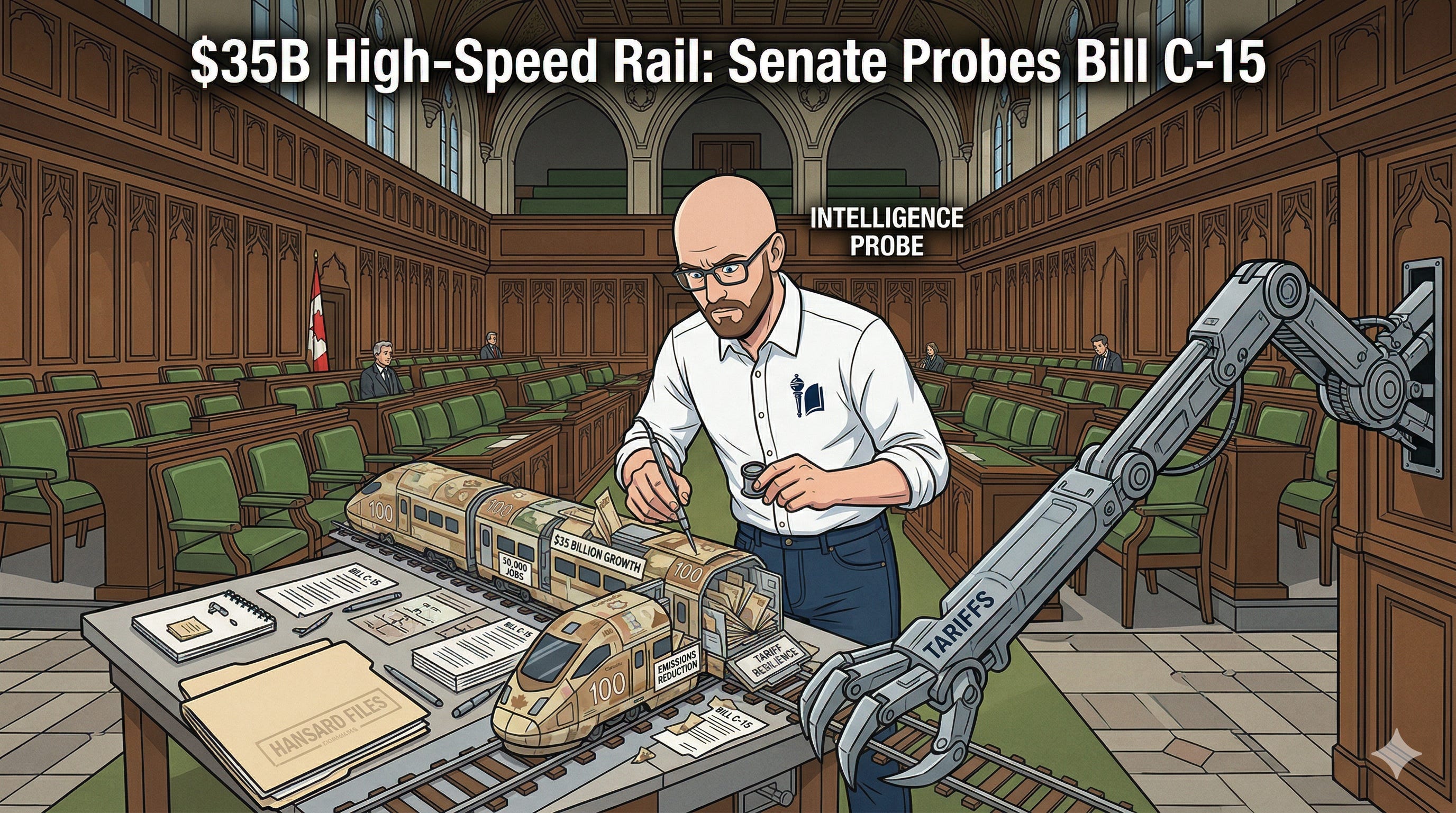
Ottawa, March 10 and 11, 2026. As the United States imposed tariffs that threatened Canadian supply chains, senators worked late into the evening across multiple committees. The economic rupture described by the Prime Minister hung over every proceeding. In the National Finance committee room, officials outlined how high-speed rail would serve as a bold countermeasure. The project would connect 18 million Canadians, halve travel times, create over 50,000 jobs, inject $35 billion into the economy, and reduce emissions equivalent to removing 100,000 cars from the roads. At the same moment, other committees examined labour disruptions in rail and marine sectors, a national soil health strategy, the urgent search for residential school children, and oversight of budget tax credits. The Senate’s parallel work reflected a single overriding imperative: build national resilience when external shocks threaten prosperity.
The $35 Billion High-Speed Rail Transformation Under Senate Scrutiny in Bill C-15
The Standing Senate Committee on National Finance met twice in two days to examine Bill C-15, An Act to implement certain provisions of the budget tabled in Parliament on November 4, 2025. On March 11, Minister of Transport Steven MacKinnon appeared with senior officials from the Department of Transport. This was his first time before the committee in the new role. He described the high-speed rail network as the start of a generational transformation.
“Canada must once again build the ambitious, nation-building projects that have shaped our country,” MacKinnon told senators. He listed past achievements: the St. Lawrence Seaway and the Confederation Bridge. High-speed rail would follow the same tradition. The legislation, he explained, draws directly from Ontario’s Building Transit Faster Act, 2020, and Quebec’s Act respecting expropriation. The goal is to cut red tape, eliminate duplicative processes, and deliver predictable timelines.
Public consultations are already underway. More than 26,000 people have submitted comments through the online portal for the proposed Windsor-to-Quebec City corridor. The first segment between Ottawa and Montreal could open within four years. MacKinnon stressed that meaningful consultation with Indigenous communities and local landowners would remain central. Confidential Indigenous knowledge would be protected. Impact assessments and environmental reviews would be conducted for every segment. The Official Languages Act would be embedded in the project’s operations.
Senators pressed for details on how the legislation would minimise impacts on individual landowners while still allowing the network to proceed efficiently. MacKinnon replied that the measures align federal rules with provincial legislation to provide clarity and certainty for communities along the route.
A second Finance session on March 10 examined other elements of Bill C-15, including investment tax credits. Senator Elizabeth Marshall questioned officials from the Department of Finance about the carbon capture, utilisation and storage credit. She noted that the credit has existed for years, has now been expanded, and is costing billions more. Only four pilot projects currently operate in Canada. Marshall asked who evaluates effectiveness and whether the pilots will deliver results. Officials explained that Natural Resources Canada approves project plans against strict guidelines before the Canada Revenue Agency processes claims. Payments are made only after investments are actually made and verified.
Labour Stability in Rail and Marine Sectors Amid Tariff Shocks
While Finance focused on Bill C-15, the Standing Senate Committee on Transport and Communications convened on March 11 to study the maintenance of essential services during labour disruptions. Minister of Jobs and Families Patty Hajdu appeared with Deputy Minister Rob Wright and Senior Assistant Deputy Minister Gary Robertson. Hajdu described the timing as critical. Transportation disruptions had already occurred because of the tariffs.
Hajdu reviewed the Canada Labour Code requirement that parties identify activities needed to prevent immediate and serious danger to public safety or health. She noted that 2024 legislative changes now require parties to agree on maintenance of activities at the very beginning of bargaining. “In the heat of the moment, it can be very difficult to even agree on very simple things once emotions are high,” she said. The minister emphasised relationships, early mediation through the Federal Mediation and Conciliation Service, and the work of long-serving officials who prevent strikes that could further damage supply chains. She praised the fine balance the government must strike between workers’ right to strike, meaningful collective bargaining, and economic stability.
Clause-by-Clause Progress on National Soil Health Strategy
On March 10, the Standing Senate Committee on Agriculture and Forestry resumed clause-by-clause consideration of Bill S-230, An Act respecting the development of a national strategy for soil health protection, conservation and enhancement. Officials from Agriculture and Agri-Food Canada sat ready to answer technical questions. Senator McNair moved an amendment on behalf of Senator McBean to clause 3. The change replaced earlier wording with explicit references to “Indigenous and non-Indigenous representatives of agricultural industry and organizations; and any interested persons.” Senator Burey supported the amendment, stating it captured the committee’s commitment to inclusivity. The motion carried by consensus. Clauses 4 and 5 then passed without further debate.
Sacred Work Facing Funding Cliff: Search for Residential School Children
At the Standing Senate Committee on Indigenous Peoples, also on March 10, Raymond Frogner, Head of Research, Archives and Collections at the National Centre for Truth and Reconciliation, delivered a sobering update. Speaking from the University of Manitoba campus, he reminded senators of their own July 2023 interim report. That report had called the work of locating missing children “important, urgent and sacred” and had demanded adequate, predictable, stable and long-term federal funding.
Two years later, Frogner reported, Survivors, families and communities remain in the dark. The Residential School Documents Advisory Committee suspended operations in October 2024 after the federal government declined additional resources. An estimated 20 million previously unreleased federal records still await transfer to the Centre. The National Advisory Committee on Residential Schools Missing Children and Unmarked Burials has seen its funding lapse. Core funding for the National Centre itself expires in March 2027 with no renewal confirmed.
Frogner warned that short-term funding cycles raise hopes, reopen old wounds, and fail to deliver results. “Rushing this work harms Survivors, families and their communities,” he said. Michael DeGagné, Co-Chair of the National Council for Reconciliation, joined the discussion in person. Senators heard that complex, highly sensitive archival and verification work cannot be rushed if it is to be done correctly.
Internal Oversight and Technical Delays
The Standing Committee on Audit and Oversight met briefly on March 11. Chair Senator Marty Klyne noted technical issues had forced postponement of the public discussion on the external audit. The committee moved in camera to continue its work.
Across these five committees in just two days, senators examined interlocking pieces of Canada’s response to economic pressure. High-speed rail under Bill C-15 stood as the flagship infrastructure answer, promising jobs, growth and emissions reductions. Soil health legislation moved forward with broader stakeholder inclusion. Labour rules aimed to prevent disruptions that could worsen tariff damage. Reconciliation obligations for residential school records faced a funding cliff. Tax credits and internal audits received close financial scrutiny. The proceedings demonstrated the Senate’s role in testing whether ambitious legislation can deliver when external threats intensify.
Hansard Files digs through dense Senate transcripts to surface these pivotal stories. Subscribe to support independent investigative coverage of Parliament’s work.
Source Documents
Senate of Canada. (2026, March 10). Evidence of the Standing Senate Committee on Agriculture and Forestry, 44th Parliament, 1st Session.
Senate of Canada. (2026, March 11). Evidence of the Standing Senate Committee on Transport and Communications, 44th Parliament, 1st Session.
Senate of Canada. (2026, March 10). Evidence of the Standing Senate Committee on Indigenous Peoples, 44th Parliament, 1st Session.
Senate of Canada. (2026, March 11). Evidence of the Standing Committee on Audit and Oversight, 44th Parliament, 1st Session.
Senate of Canada. (2026, March 11). Evidence of the Standing Senate Committee on National Finance, 44th Parliament, 1st Session.
Senate of Canada. (2026, March 10). Evidence of the Standing Senate Committee on National Finance, 44th Parliament, 1st Session.
Too many people share a common misapprehension about the role that the Senate plays, and can play even more: they’re seen as a bunch of costly layabouts, living the high life and doing absolutely nothing for the country in return.
The glass-half-full view would be that it’s a resource we could make better use of, a group of people with a broad range of knowledge and experience who could represent a, well, an at lest *more* objective review of important and complex legislation, including impacts on the country, its various regions, communities and interests.
I think this offers a great example of how it can save a bunch of committee development time and money, lean in on some of the expertise of individual Senators, and benefit from this resource, helping to achieve one of Carney’s stated goals (faster, cross-interest — ie truly national —, review of major project proposals as we wheel to face the new American threats to our economy and even our sovereignty.
It may not be perfect as it is, but changes to how one becomes a Senator, regional representation, term limits and a few other aspects could make it even more valuable resource. Let’s not kill it off to save a comparatively small amount of money; let’s look at hard at how it could be better formed and utilized…and make those changes.
We still need a way to get people out of their cars and onto trains in that corridor. With the price of flying about to go out of reach, and possibly make even driving hybrids too expensive, we need to get building.
As a reference point, the rail line between the Shanghai airport and the train terminal reaches speeds over 450km/hr, and when I got to ride in 2013, it was well proven. Fast connections like that abound in the rest of the world. Why should we be slaves to driving over crumbling roads?
It is time we caught up to the rest of the world, and not languish beside a failed state to our south. Amtrac is in the same boat as VIA. No political will or capital has been spent on passenger rail service since they were created.
If we are serious about building Canada into a strong sovereign nation, building more rail lines for passengers and cargo will be one of the foundations for us to build on.
Nous nous souviendrons.
We are Canadian.