


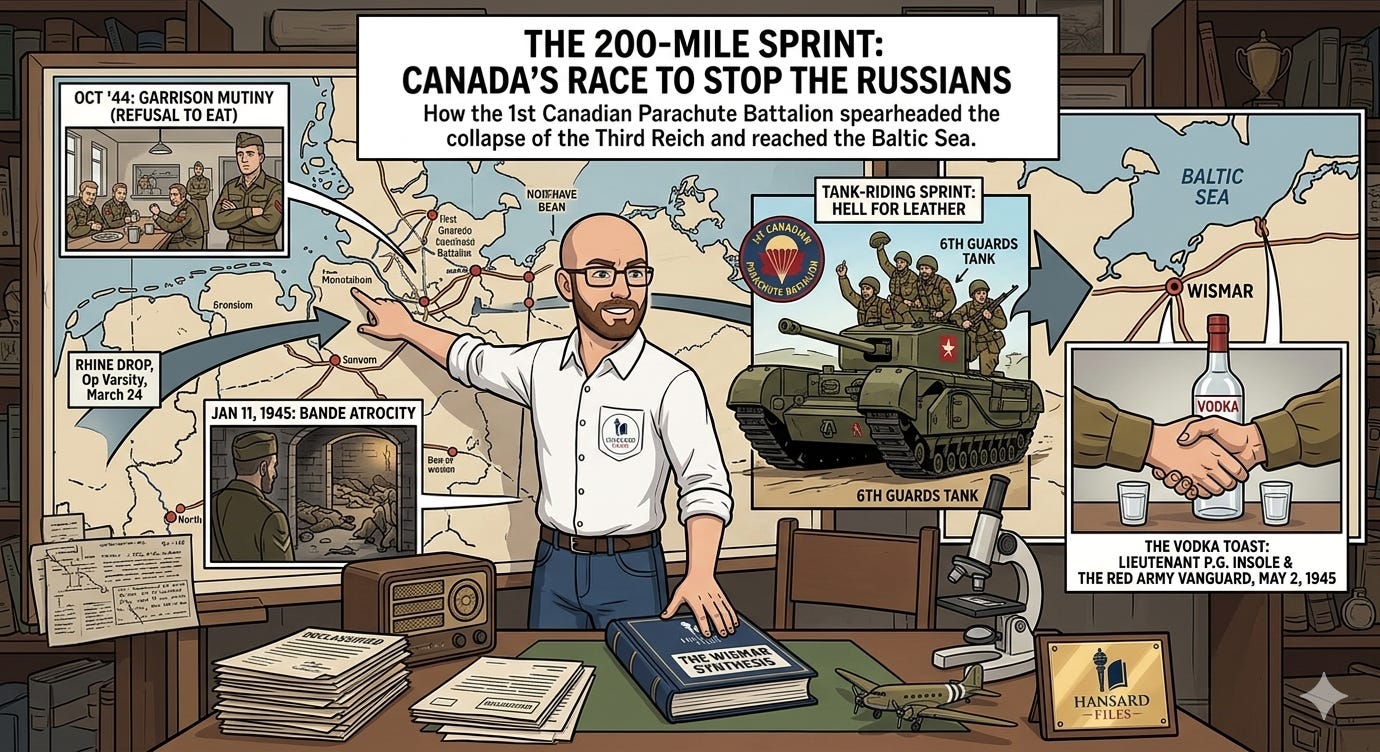
The air armada stretching across the sky on March 24, 1945, was so vast it took two hours and thirty-two minutes to pass a single point on the ground. Inside thirty-five C-47 transport planes, the men of the 1st Canadian Parachute Battalion sat heavy with gear, waiting for the green light that would drop them onto the east bank of the Rhine.
This was Operation Varsity, the largest single-day airborne drop in history. Unlike the stealthy night jumps of Normandy, this was a daylight assault—a brazen, high-noon hammer blow designed to shatter the final German defensive line. But as the Canadians hooked up their static lines, they were jumping into a command vacuum. Their Commanding Officer, Lt. Col. Jeff Nicklin, a former Winnipeg Blue Bombers star who had survived the drop into Normandy, would not survive the landing. By the time the Battalion consolidated on the ground, Nicklin was dead, and the unit was leaderless in the chaos of a drop zone teeming with enemy fire.
What followed was not a retreat, but one of the most aggressive advances of the war—a relentless, tank-riding sprint across Northern Germany to beat the Soviet Red Army to the Baltic Sea.
The Hunger Strike
Five months before the Rhine drop, the Battalion was fighting a very different kind of war: a war of wills against its own leadership. In October 1944, back in England after the brutality of Normandy, the unit’s morale fractured. On the evening of October 20, “great confusion was caused when the men refused to eat.” The strike wasn’t about the food quality, but “the treatment of the men by the Commanding Officer”.
For three days, the strike held. On October 21, only 60 men ate supper. By October 22, the refusal to eat continued, forcing Brigadier James Hill to intervene personally, promising an investigation into all grievances. It was a rare moment of internal discord for an elite unit, fueled by the decompression from combat and the chafing restrictions of garrison life. The “mutiny” dissolved without court-martials, but it revealed a unit coiled tight, desperate for the release of action.
They got it in December. As the Germans launched their desperate counter-offensive in the Ardennes—the Battle of the Bulge—the Canadians were rushed from their Christmas dinners in England to the freezing forests of Belgium. They were the only Canadian unit to face the German offensive in the Ardennes.
The Cellar at Bande
The Ardennes campaign was a bitter, freezing infantry slog, far removed from the glamour of airborne warfare. The Battalion patrolled aggressive defensive lines, often finding the enemy had melted away before them. But on January 11, 1945, in the village of Bande, they uncovered the true face of their enemy.
Soldiers from the Battalion discovered a cellar containing the bodies of 37 civilians. They had been “beaten and shot to death” by the retreating Germans. The atrocity was so stark that the Battalion command ordered one man from every platoon to view the scene, ensuring the troops understood exactly what they were fighting to extinguish.
Following the Ardennes, the Battalion was shifted to the Netherlands, holding a static line along the River Maas. It was a miserable, waterlogged posting where “enemy shells and rockets fell into the unit area time after time”. For weeks, they traded mortar fire and conducted patrols in rising floodwaters, waiting for the order to return to their primary role: falling from the sky.
“Hell for Leather”
That order finally came in mid-March 1945. The Battalion was pulled back to England for a brief, frantic refit. Between briefings for the Rhine jump, the men killed time with “volleyball, softball, basketball,” and sunbathing in the unseasonably warm weather.
The drop on March 24 was a tactical masterstroke. By landing east of the Rhine after the amphibious assault had begun, the airborne forces totally disrupted the German rear. Despite the loss of Lt. Col. Nicklin and other officers in the initial drop , the Battalion seized its objectives—a critical road junction and the woods skirting the drop zone. The Airborne Corps captured 3,500 prisoners in a single day.
With the Rhine breached, the nature of the war shifted instantly from a methodical slog to a high-speed chase. The 1st Canadian Parachute Battalion boarded the hulls of the 6th Guards Tank Brigade, inventing a new form of warfare on the fly. No longer foot soldiers, they were now mechanized infantry, riding exposed on the backs of Churchill tanks as they tore into the German heartland.
The advance was relentless. On March 30, near Coesfeld, the column crested a hill to see a German convoy fleeing north in the valley below. The tanks didn’t hesitate. They rushed “hell for leather” down the steep tarmac road, turrets revolving to strafe the retreating trucks with Besa machine-gun fire. They didn’t even slow down to inspect the wreckage, crushing enemy staff cars and cyclists under their treads as they sped through village after village.
The Race to the Baltic
By late April, the strategic goal had shifted. It was no longer just about defeating Germany; it was about checking the Soviet advance. The Russians were driving hard from the East, and Field Marshal Montgomery ordered a dash to the Baltic port of Wismar to prevent the Red Army from moving into Denmark.
The Canadians covered 200 miles in a matter of days. The pace was grueling. Pockets of resistance were often bypassed or flattened by the leading tanks. On May 2, the Battalion reached Wismar, effectively sealing off the Danish peninsula. They had advanced deeper into Germany than any other unit in the Canadian Army.
The scene in Wismar was apocalyptic. The town was flooded with “German refugees and soldiers” coming through the lines by the thousands, fleeing the terrifying reputation of the advancing Soviets.
That night, the two great Allied armies finally met. A Russian officer arrived in a jeep to make contact. The formal “handshaking and Vodka-drinking” was handled by Lieutenant P.G. Insole of B Company, who toasted the end of the Third Reich with the vanguard of the Red Army.
End of the Line
The war effectively ended there, on the shores of the Baltic. On May 5, the German forces in Northwest Europe surrendered. The Battalion, having fought from the drop zones of Normandy to the cobblestones of Wismar, began the process of repatriation.
The cost of their journey was etched into the unit’s roster. The appendices of their final report list the decorations won—Military Crosses, Distinguished Conduct Medals—but also the gaps in the ranks. They had been the only Canadians to fight in the Ardennes, the first to cross the Rhine in daylight, and the first to meet the Russians. They returned to Canada not just as paratroopers, but as the tip of the spear that had finally broken the back of the enemy.
The Hansard Files scours declassified military reports, war diaries, and forgotten transcripts to bring you the raw, unpolished history of the Canadian experience. Subscribe today to support independent historical journalism.
Source Documents
Historical Section (G.S.) Army Headquarters. (1947, October 27). Report No. 17: The 1st Canadian Parachute Battalion in the Low Countries and in Germany Final Operations.
What a good read. 81 years ago ...
You provide such a satisfying read, I had to read it aloud to my spouse and children.