


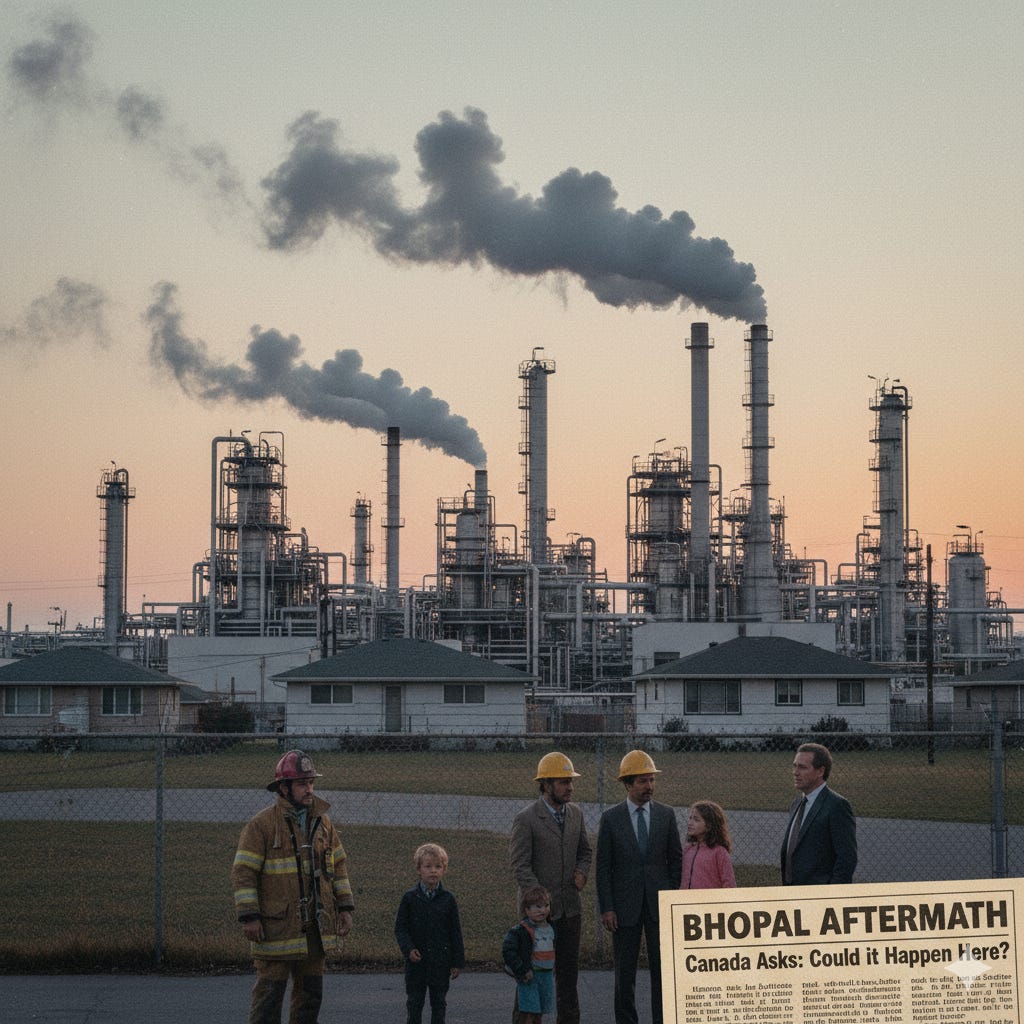
The 1984 chemical disaster in Bhopal, India, was a tragedy of almost unimaginable scale, killing over 2,000 people and injuring tens of thousands. It sent a shockwave through the industrialized world, forcing nations to confront a deeply uncomfortable question: could it happen here? A federal summary report from February 1986, titled Bhopal Aftermath Review, provides a stark and revealing look at how Canada’s own government and industry leaders grappled with that very question. The document is more than a historical artifact; it’s a blueprint of the anxieties and systemic frailties that exist when communities live in the shadow of industrial risk.
Could a Bhopal Happen Here?
The report doesn’t mince words. After reviewing the landscape of Canadian industry, the steering committee, a joint body of government and industry representatives, came to a clear conclusion. The chemicals involved in the Bhopal incident were not manufactured in Canada, but “other chemical agents equally dangerous are made and used in this country”. The possibility for a major industrial accident, the report states, “is always present”.
What does this risk actually look like? The committee found a direct correlation between the chemicals most commonly used in Canadian industry and those “spilled in greatest volume and frequency”. This wasn’t a theoretical danger. The review was framed by recent Canadian emergencies, including the 1979 Mississauga train derailment that forced the evacuation of over 200,000 residents and the 1982 sour gas well blowout in Lodgepole, Alberta. These events served as proof that the potential for catastrophe was real. The report’s primary function was to move the country from a reactive footing to a preventative one.
A System of Fractured Responsibility
Perhaps the most critical insight from the 1986 review is its portrait of a fractured system of oversight. It identifies a web of responsibility shared between industry, municipalities, and provincial and federal governments, with no single entity holding the reins. The report makes it clear that industry has the “ultimate managerial responsibility for loss prevention”. Companies are urged to conduct site-specific risk assessments, minimize their inventories of hazardous materials, and perform regular, rigorous safety audits.
But private industry can’t operate in a vacuum. The report points a finger at municipal land-use planning, noting that in many Canadian communities, “residential areas have spread to the fencelines of industrial or storage sites leaving little or no buffer space”. It calls on municipalities to create buffer zones and on senior governments to provide the guidance and resources to do so. This reveals a fundamental tension: local officials face immense pressure to allow development, yet they are also the first line of defense for the community.
The Information Problem
This fractured responsibility created a significant information problem. How can a community prepare for a risk it doesn’t understand? The review wrestled with the concept of the public’s “right-to-know.” While acknowledging that the public has a right to know if nearby chemicals could harm them, the committee stopped short of recommending national legislation, citing “legal and constitutional concerns” and calling for further study.
This hesitancy stood in contrast to the clear need for information exchange. The report recommended that companies provide Material Safety Data Sheets to local officials and that a central “clearing house” be established for this data. It also found that while spill reporting for transportation accidents was mandatory, reporting for releases from plant sites was inconsistent and often voluntary, creating significant gaps in the national data. Without complete and accessible information, how could any level of government truly assess the national risk profile?
Planning for the Worst
If prevention fails, response is everything. The report highlights significant weaknesses in Canada’s emergency preparedness. It notes that while major corporations often have robust contingency plans, the same cannot be assumed for the small and medium-sized operations that also handle dangerous chemicals.
A recurring theme is the immense burden placed on local first responders, like firefighters and police. The report bluntly states that in many situations, these individuals “do not have the benefit of this training” and may be volunteers who have never handled a chemical accident. The most crucial skill, the committee argues, is not for every firefighter to be a chemical expert, but for them to know how to access expertise quickly. This requires a tight, well-practiced integration between local responders, industry experts, and government agencies. To that end, the report strongly recommends that all emergency organizations conduct regular simulation exercises to test their plans, citing programs in Sarnia and Fort Saskatchewan as models.
The Data Brief
A Clear and Present Danger: The 1986 report confirmed that Canada manufactured, used, and transported chemicals with the potential to cause a “Bhopal-type incident.”
Fractured Oversight: Responsibility for preventing accidents was found to be spread thinly across plant operators, municipal planners, and provincial and federal regulators, with a need for stronger leadership and coordination.
The “Right-to-Know” Dilemma: The committee acknowledged the public’s right to information about local chemical hazards but deferred recommending national legislation, calling it an issue for further study.
Gaps in Emergency Response: The review identified an urgent need to improve training for local first responders, strengthen contingency planning across all industries, and regularly test emergency plans through simulations.
Inconsistent Data: A major weakness identified was the lack of mandatory reporting for chemical spills at industrial plants, creating an incomplete picture of the national risk.
A Question of Commitment
Ultimately, the Bhopal Aftermath Review is a call for a profound shift in mindset. It argues that safety cannot be a passive state; it requires constant vigilance, foresight, and collaboration. The document concludes not with a technical recommendation, but with a powerful warning about civic responsibility. Real protection, it states, depends on the “personal commitment of politicians, industrialists, workers, public officials and the general public”. If that collective commitment wavers, the report warns, “then we may face the consequences of a Canadian Bhopal”. It is a stark reminder that the systems we build to protect ourselves are only as strong as the people who run them.
Source Documents
Steering Committee representing Agriculture Canada, Alberta Energy Resources Conservation Board, Canadian Association of Administrators of Labour Legislation, Canadian Chemical Producers’ Association, Canadian Petroleum Association, Canadian Transport Commission, Emergency Planning Canada, Environment Canada, Health and Welfare Canada, Petroleum Association for the Conservation of the Canadian Environment, Regional Industrial Expansion, & Transport Canada. (1986). Bhopal Aftermath Review: An Assessment of the Canadian Situation. Environment Canada.