


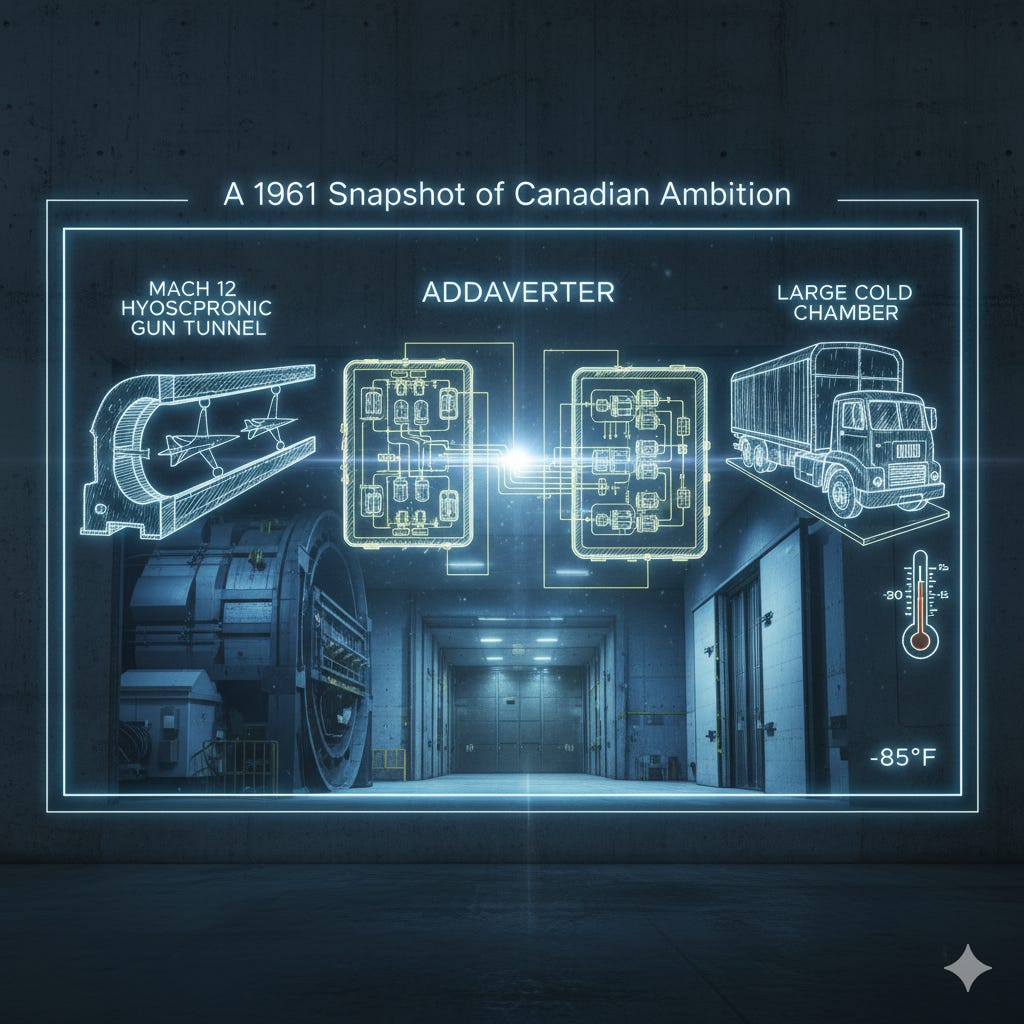
A 1961 report from the National Research Council (NRC) provides a fascinating, detailed inventory of Canada’s top-tier experimental hardware. The document, “Experimental facilities of the Division of Mechanical Engineering and the National Aeronautical Establishment,” lists the tools available to the nation’s brightest minds. What does this snapshot from the dawn of the Jet Age and the Space Race tell us about Canada’s scientific priorities and industrial capacity? It reveals a nation investing heavily in the core challenges of its time: mastering high-speed flight, conquering a harsh climate, and building the infrastructure for a modern economy.
Mastering the Air and Beyond
The inventory for the National Aeronautical Establishment (NAE) is a clear indicator of Cold War priorities. The facilities were not just for simple flight, they were for fast flight. The list includes a 5-ft. x 5-ft. Blowdown Wind Tunnel capable of testing models at Mach 4.5. It even features a Hypersonic Gun Tunnel designed to simulate conditions at Mach 12, with temperatures reaching 2,000°K, aimed at measuring heat transfer and forces on small models.
This wasn’t just about building better passenger planes. Other facilities were designed for testing models of missiles. This was about understanding the extreme physics of high-speed aerospace. On the other end of the spectrum, the NAE also ran a vertical wind tunnel and a VTOL (Vertical Take-Off and Landing) test rig, showing a clear focus on this emerging aircraft technology.
The Canadian Problem: Conquering the Cold
While the NAE looked to the skies, the Division of Mechanical Engineering (DME) was squarely focused on earthly, and particularly Canadian, problems. You can see this in the extensive environmental chambers. The report details a Large Cold Chamber, 50 ft. long, capable of being cooled to -85°F or heated to +160°F, for testing large engineering equipment.
It also lists three separate icing tunnels:
An 8-in. x 10-in. Instrument Icing Tunnel for small components.
A High Speed Variable Density Icing Tunnel that could simulate conditions up to Mach 0.9 at 30,000 ft.
A 4-ft. x 4-ft. Low Speed Icing Tunnel.
Why this emphasis? For a nation reliant on aviation and resource development in the North, understanding how equipment behaves in extreme cold and icing was not an academic luxury. It was a core requirement for national safety and economic development. The DME even operated a helicopter icing rig to test rotorcraft in an artificial cloud during winter.
The Digital and Analogue Brain
In 1961, “computer” did not just mean one thing. The NRC operated a sophisticated mix of technologies. The report lists two Bendix G.15 digital computers, but also two powerful analogue computers, the PACE 16-131R and the “Ease” system. Analogue computers were essential for simulation studies and analogue computations, such as modeling the dynamic behaviour of aircraft.
The most advanced piece of kit, however, was the “Addaverter.” This device coupled the analogue and digital computers together, allowing for combined simulations. This hybrid approach represented the cutting edge of computation, merging the real-time simulation power of analogue with the precision of digital calculation.
Powering the Nation
The report’s scope extends far beyond just planes and computers. The DME had massive engine test cells, capable of handling turbojet engines with 25,000 lb. of thrust and propeller engines up to 4,000 h.p. This was paired with a sophisticated Fuels and Lubricants lab, which used tools like gas chromatographs and spectrophotometers to evaluate everything from aviation turbine fuel to diesel engine oils.
From Harbours to Hulls
The NRC’s mandate also covered civil and naval engineering. The Hydraulics Laboratory had a 420-ft. long area for model studies of harbours, river training works, and navigation locks. This included a 185-ft. wave flume for investigating wave problems.
Separately, the Ship Test Facilities included:
A Model Basin 450 ft. long by 25 ft. wide, equipped with a towing carriage.
A Manoeuvring Basin 200 ft. by 400 ft., for conducting turning tests on radio-controlled models.
A Model-Cutting Machine for carving 25-ft. long ship models from wood or wax.
This was infrastructure built to support a maritime and trading nation.
The Data Brief
The 1961 NRC report provides a blueprint of a nation building its scientific sovereignty.
Key assets were split between the National Aeronautical Establishment (NAE) and the Division of Mechanical Engineering (DME).
NAE focused on high-speed, Cold War-era aerospace, with facilities for testing at hypersonic speeds (Mach 12) and for VTOL aircraft.
DME focused on practical Canadian challenges, particularly engine performance, fuels, and operations in extreme cold, with multiple large-scale icing tunnels and cold chambers.
The facilities included advanced (for 1961) hybrid analogue-digital computing, large-scale hydraulics labs for harbour modeling, and massive ship-testing basins.
A Foundation in Steel and Concrete
This 1961 document is more than a simple inventory. It is a physical manifestation of Canada’s post-war ambitions. The sheer scale of the investment, from hypersonic tunnels to 450-ft. ship basins, shows a clear understanding that to be a serious industrial nation, you had to build and own the tools to solve your own problems. This was the hardware that would underpin Canadian innovation for decades.
Source Documents
National Research Council Canada. Division of Mechanical Engineering, & National Research Council Canada. National Aeronautical Establishment. (1961). Experimental facilities of the Division of Mechanical Engineering and the National Aeronautical Establishment of the National Research Council (Miscellaneous Report No. NAE misc. 22). National Research Council Canada.
A fateful reminder of what this country aspired to before falling into the Conservative spider web of free trade with the US. Once in the web, we became increasingly entangled and trapped until we were immobilized. Here’s hoping that the events of 2025 have reignited our drive and energy. Electing and supporting Carney, centrist though he may be, is a good attempt at breaking out.
Fascinating research. Thank-you.