


In June 1931, thousands of enumerators fanned out across a Dominion broken by economic collapse. They walked the dusting-bowl roads of the Prairies and climbed the tenement stairs of Montreal to collect the raw data for the 1931 Canadian Census demographics. What they found was not merely a snapshot of the Great Depression but the statistical obituary of a way of life. The large, self-sufficient pioneer family, once the bedrock of Canadian survival, was vanishing. In its place stood a new, fragile unit: urban, crowded, and terrifyingly poor. The data, later compiled into the haunting Census Monograph No. 7, revealed that while the nation’s population was growing, its families were shrinking, stalling, and starving.
The monograph, published seven years after the count, offered a retrospective that reads like a warning. It stripped away the nostalgia of the family farm to reveal a harsh arithmetic: the average wage-earner was failing to keep pace with his dependents. The result was a demographic contraction that would reshape the nation long before the first shot of the Second World War was fired.
The Arithmetic of Survival
For nearly three centuries, the Canadian family had been defined by a simple equation: more children meant more labor, which meant survival. In 1666, the first census of New France recorded a population of 3,215 souls, with families expanding rapidly to fill the vast, empty continent. By 1931, that expansionist momentum had hit a concrete wall. The enumerators discovered that the “biological family”—the parents and their immediate offspring—was being replaced by the “census family,” a catch-all term for households held together by economic necessity rather than blood.
The average size of the household had been in steady decline since Confederation in 1867. This was not an accident. It was a reaction to the urbanization of the Canadian soul. As the population concentrated in cities, children transformed from agricultural assets into financial liabilities. The monograph noted that the decline in rural family size ran parallel to the development of railways and highways. The very infrastructure built to connect the nation was dismantling its traditional social unit. The “commercialization of farming” meant that even in rural areas, the logic of the market was superseding the logic of the cradle.
This shift created a new demographic category: the “unfilled family.” These were couples who, paralyzed by the economic terror of the 1930s, delayed marriage or limited their offspring. The census heads noted that the average Canadian man did not assume family responsibilities until he was nearly twenty-seven years old. His earnings rose until he was forty-five, but they rarely rose fast enough to support a large brood. The data proved that financial caution had become the most effective contraceptive. The report bluntly stated that the disparity between wages and the cost of dependents was the primary “incentive for limiting the size of his family.”
The Urbanization Trap
The 1931 Census shattered the myth that the city was a place of opportunity for the family unit. Instead, it revealed the city as a zone of compression. In a finding that puzzled even the statisticians, urban households in some historical periods appeared larger than rural ones. This was not because city dwellers were having more children. It was because they were packing more strangers into their homes.
The “lodger” became a central figure in the Canadian home. The census tracked the “lodging population” as a massive, floating demographic of single men, women, and broken families who could not afford their own front door. In the cities, the private family was forced to absorb these outsiders to pay the rent. The privacy of the nuclear family was a luxury that the Depression had eroded. The enumerators found that 86 percent of private families consisted of a husband and wife living together, but the walls around them were often shared with boarders, distant relatives, or guardianship children.
This crowding concealed a deeper hollowness. The “completed family”—a woman who had passed her child-bearing years—was shrinking. The report’s authors, using a tone of clinical detachment, observed that Canadians were “rapidly becoming a non-fertile race.” They warned that comparing the 1931 family to the “grandparents’ family of 10” was no longer just nostalgia; it was a comparison between two different civilizations. The modern urban environment, with its demand for cash wages and indoor labor, had made the ten-child family an economic impossibility for all but the very wealthy or the very rural.
The Poverty of the Cradle
The most devastating statistic buried in the 1931 data concerned the welfare of the next generation. The census analysts broke down families by the “earnings class” of the head of the household. The correlation they found was stark and horrifying. Small children were most numerous in the families with the lowest earnings.
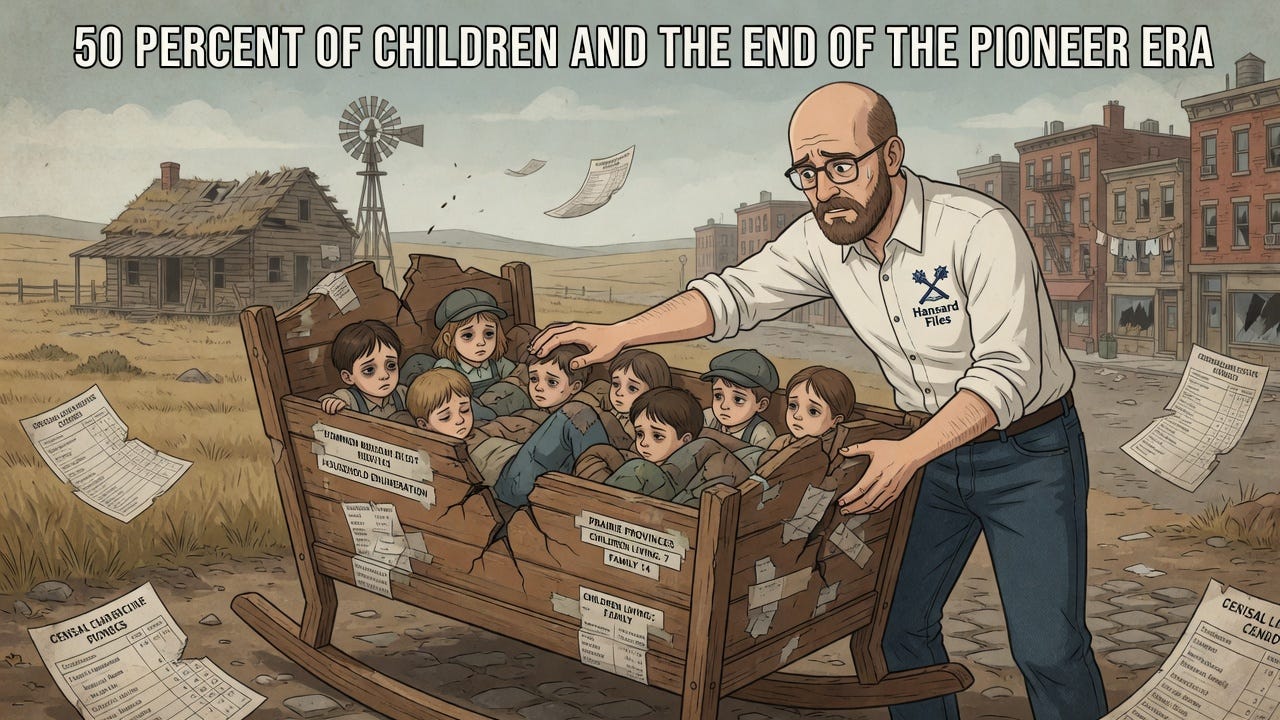
The numbers were precise and damning. nearly 50 percent of all children under the age of seven were being reared in families where the head earned between $50 and $1,449 per year. The report explicitly stated that these children were being raised under “conditions of near poverty.” This was not a marginal issue affecting a few unlucky pockets of the country. It was the defining experience for half of Canada’s youngest citizens.
The data showed that as earnings rose, the number of young children fell. The “prosperous” families were small, protecting their standard of living by limiting their dependents. The poor had no such buffer. The enumerators found that in the lowest income brackets, the burden of survival often fell on the children themselves. The “gainfully occupied child” was a common entry in the ledger. In families where the father earned a pittance, the children were sent to work, their small wages essential to keeping the household afloat. The census revealed a nation where the burden of the Depression was being disproportionately carried by those too young to vote.
The Quebec Exception
Amidst this national contraction, one region stood as a defiant outlier. Rural Quebec refused to follow the statistical trend of the English-speaking provinces. The monograph dedicated significant space to analyzing the resilience of the French-Canadian family. In counties like Chicoutimi and various parishes along the St. Lawrence, the large family remained the norm.
The statisticians struggled to isolate the cause. They looked at religion, noting the influence of the Roman Catholic Church, but they also looked at the land itself. They found a correlation between “colonization” and fertility. In the newly settled districts of Quebec, where there was still room to expand, the birth rate remained high. The “pioneer family” was not dead; it had simply retreated to the frontiers of the French-speaking world.
However, even in Quebec, the pressure of density was being felt. In the long-settled seigneuries, where the land could no longer be subdivided, the family size began to drop. The census showed that biology was ultimately subservient to geography. When the land filled up, the cradles stayed empty. The “steady decline” observed in the rest of Canada was creeping into the rural heartland of Quebec, slowed only by a cultural imperative to survive through numbers.
The End of an Era
The 1938 monograph that analyzed these findings acted as a closing argument for the nineteenth century. It documented the transition of the family from a unit of production to a unit of consumption. The “Census Family” of 1931 was smaller, older, and more urban than any that had come before it. It was a family unit stripped of its economic utility, existing in a world that had not yet built a social safety net to support it.
The enumerators of 1931 could not know that a world war and a subsequent baby boom would temporarily reverse these trends. They saw only the immediate wreckage of the Depression. They saw fathers who could not afford to be fathers, and houses that were full of people but empty of children. The “typical” Canadian household had ceased to be a homestead and had become a boarding house, a temporary shelter against the economic storm.
The legacy of the 1931 census is the revelation of how quickly economic forces can reshape the most intimate aspects of human life. In the span of two generations, the large, sprawling Canadian family had been whittled down by the twin blades of urbanization and poverty. The 4.2 persons sitting around the average dinner table in 1931 were not just a statistic. They were the survivors of a demographic revolution that had quietly, ruthlessly, ended the pioneer era.
If you enjoyed this deep dive into the archives, consider subscribing to Hansard Files. We scour thousands of pages of forgotten government reports to uncover the stories that shaped our history, so you don’t have to.
Source Documents
Dominion Bureau of Statistics. (1938). The Canadian Family (Census Monograph No. 7).
Very interesting account thank you but with this caveat over the claim that the shrinkage of large families was caused by the economy alone. Surely the impact of the Great War losses, the rapid rise of mechanized grain farming and the magnetic pull to cities offering employment and entertainment also strong vectors in the dwindling of standard size of families reducing their memberships. Living standards were in fact increasing and single people began to be able to live on their own rather than necessarily living under the paternal roof.