


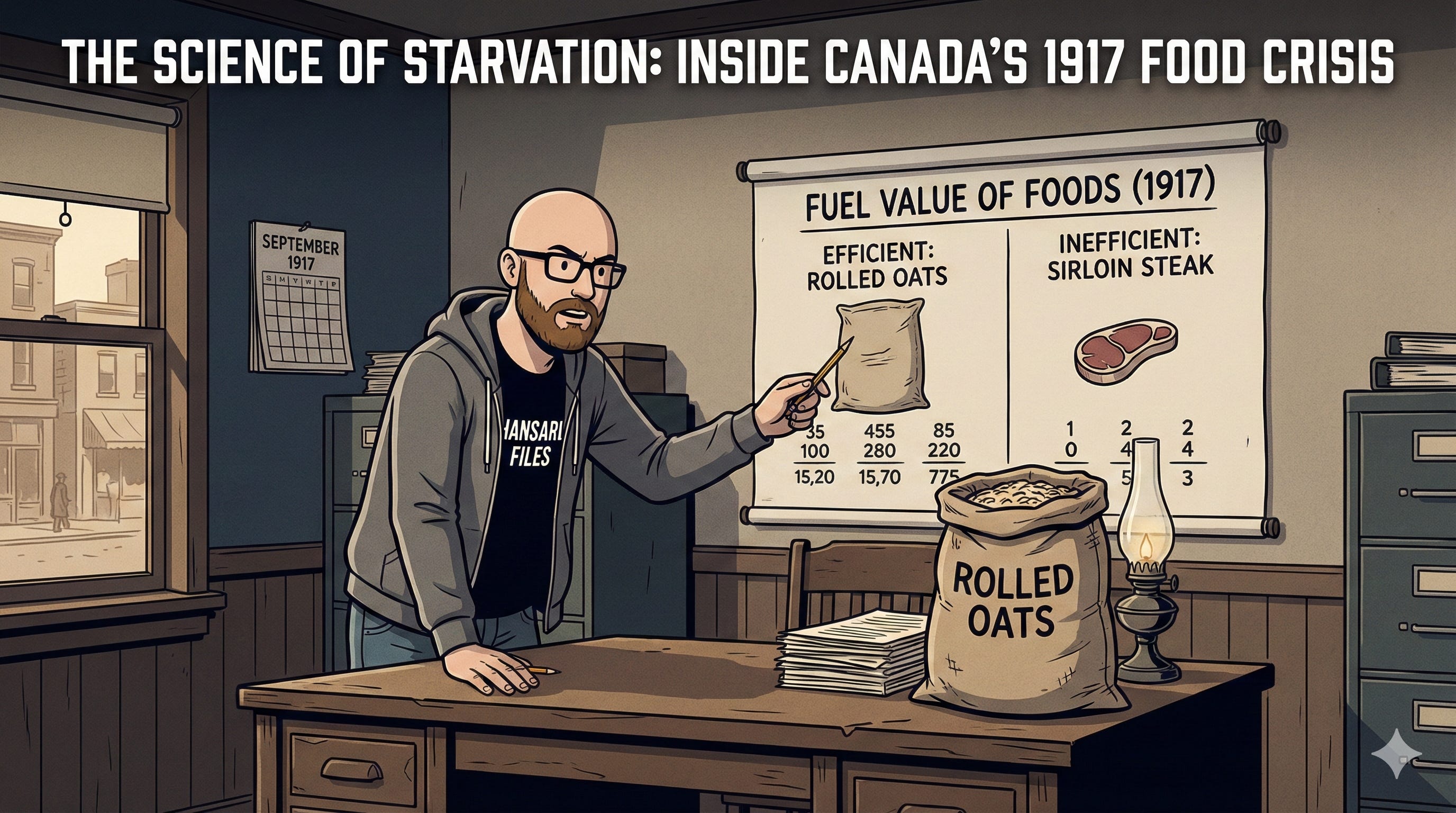
In September 1917, while the Great War ground through its fourth year of attrition in Europe, a different kind of battle plan was being drawn up in Ottawa. This one didn’t involve artillery shells or trench coordinates. It involved rolled oats, skim milk, and a ruthless calculation of the human body’s minimum requirements for existence.
The architect of this plan was Dr. P.H. Bryce, the Chief Medical Officer of the Department of the Interior. While generals tallied casualties, Bryce tallied calories. He looked at the nation’s dinner tables and saw not sustenance, but dangerous inefficiency. At a moment when the Allied food supply was tightening into a stranglehold, Bryce issued a report that stripped the romance from eating, reducing the Canadian citizen to a biological engine requiring a specific amount of fuel.
His report, Production and Preservation of Food Supplies, is a startling document of technocratic desperation. It reveals a moment in history when the government stopped viewing food as a matter of personal taste and started viewing it as a matter of national security. In the 1917 food supply crisis, there was no room for “fashion” in eating. Every apple left to rot and every gallon of cream churned into ice cream was an act of treason against the laws of thermodynamics.
The Lucullus Feast vs. The Police Ration
Bryce’s central thesis was cold and precise: human living needed to be “standardized.” Just as the military standardized ammunition, the state needed to standardize hunger.
“It may be postulated that human living should be standardized in terms of human needs and rational aspirations,” Bryce wrote, arguing that science now gave the government the power to define exactly what those needs were. He stripped away the social rituals of dining, presenting the human being as an animal requiring protection from “wild beasts and climate” and a specific caloric intake to function.
To illustrate the gross inequality of the era’s food consumption, Bryce drew a sharp contrast between the “Lucullus feast of gourmets in a New York hotel at $25.00 a plate” and the standardized rations of a scientific experiment conducted on the New York Police Department. The gourmet and the beat cop were the same biological species, yet their consumption was vastly different. For a nation at war, the gourmet was a liability.
Bryce knew he couldn’t legally mandate starvation rations. “It would be absurd to propose... that there should be laws passed requiring that each person should live strictly within the limits of such food requirements,” he admitted. But he could use the weapon of data to shame the public into compliance. He presented a new kind of accounting, where the currency was not dollars, but “fuel value.”
The Mathematics of Survival
The core of Bryce’s argument was a brutal economic takedown of the North American diet. He deployed data from the Ontario Agricultural College to prove that the average citizen was hemorrhaging money—and nutrients—on the wrong foods.
He presented a table showing the “Protein, Fat, Carbohydrates and Fuel Value of One Dollar’s Worth of Each Food,” a chart that acted as a moral scorecard for the grocery shopper. The results were stark:
Rolled Oats: For one dollar, a consumer purchased 2.5 pounds of protein and nearly 37,000 calories of energy.
Sirloin Steak: For the same dollar, the consumer got only 0.66 pounds of protein and a paltry 4,000 calories.
Eggs: Even worse, a dollar bought only 0.37 pounds of protein.
The conclusion was inescapable. “Cereals not only stand first on the list in fuel value,” the report declared, “but they also are capable of furnishing more protein for a given amount of money expended than can be procured in meat, fish or eggs”.
Bryce was fighting a cultural war against the prestige of meat. He acknowledged that animal protein was “more easily and completely digested,” but argued that the sheer volume of cheap energy in grains made them superior for a war economy. He held up the humble oatmeal and skim milk as the patriotic ideal, citing a study where a man doing light work subsisted on just 12.5 cents per day by eating rolled oats and milk. In 1917, the steak dinner was not just expensive; it was scientifically inefficient.
The Butter Fat Insurgency
If meat was inefficient, ice cream was indefensible. In one of the report’s most fascinating sections, Bryce launched a direct attack on the burgeoning ice cream industry, framing it as a misuse of the nation’s dairy reserves.
He cited alarming statistics from Washington and Ottawa regarding the “diversion” of butter fat. In the United States, if ice cream standards were raised to match Canadian fat requirements, it would divert 75,000,000 pounds of butter fat away from the butter market. In Canada, the numbers were scaling up rapidly. Returns from just 60 ice cream manufacturers showed they were already consuming the equivalent of 2,000,000 pounds of butter annually.
For Bryce, this was a misappropriation of thermal energy. He described ice cream with disdain as “a confection designed primarily to lessen the internal temperature of the consumer on a hot day”. Why, he argued, should the country waste millions of pounds of high-energy fat on a product intended to cool people down? The consumers of ice cream “do not want additional calories,” yet they were eating up the resources needed to fuel the troops and the working class. It was a technocrat’s view of pleasure: inefficient, wasteful, and detrimental to the national aggregate.
The Rotting Orchards
Bryce’s critique extended beyond the chemistry of food to the psychology of the market. He identified a phenomenon he called “Fashion in Foods,” arguing that advertising and social pressure were tricking Canadians into abandoning their own abundant resources for imported novelties.
The apple industry provided the perfect case study. In 1914, Canada produced a massive crop of 20,000,000 bushels of apples. Yet, the country exported less than a million barrels. The result? Huge quantities of fruit were left “to decay uncollected in the orchards”.
Simultaneously, Canadian consumers were being seduced by foreign fruit. In that same year, Canada imported over $1.1 million worth of foreign fruit. Bryce lamented that “fifty years ago an orange to a Canadian boy was as precious as a silver coin,” but now, bananas and California grapes were flooding the market. This wasn’t just a change in taste; it was a failure of logistics and patriotism. The “social exigencies” and “clever business advertising” had convinced Canadians to let their own food rot while paying a premium for imported calories.
The Roller Mill Conspiracy
Bryce also took aim at the industrialization of food processing, specifically the shift from local stone mills to industrial roller mills. He argued that technology, rather than improving nutrition, was actually degrading it while raising prices.
“Up till forty years ago,” Bryce wrote with evident nostalgia, “the wheat supplied for consumption in Canada was a mixture of local spring and fall wheat, ground by stones in the local mill, the flour of which retained all the essential qualities of grain as food”.
But the modern era had introduced the “roller process.” Suddenly, grain was being fractioned and sold in “a dozen forms,” appearing on shelves as “Farinas,” “Malta Vita,” or “Grape Nuts”. The result was a marketplace filled with products “wholly out of accord with their food values”. The consumer was paying for the processing, the packaging, and the branding, rather than the raw fuel value of the wheat.
This led Bryce to call for the creation of a “Federal Food Bureau”. This bureau would not just inspect meat; it would aggressively educate the public on the “nutritive value” of their purchases. He wanted the government to intervene in the candy aisle, teaching the people “the many forms in which candies and other confections are offered for sale” and steering them back to the raw efficiency of the stone-ground past.
Class Suicide and the Single Pupil
Underlying these inefficiencies was a deeper structural crisis in the Canadian heartland. While the war demanded maximum production, the rural workforce was vanishing. Bryce pointed to a “stationary condition of production” in Ontario, the supposed agricultural engine of the Dominion.
Between 1900 and 1910, despite the booming population, the production of nearly every major crop in Ontario had decreased. Wheat production had plummeted by over 8.5 million bushels. The reason was a massive demographic shift: the boys were leaving the farm.
Bryce’s data showed that while the urban population of Canada had exploded—growing from 37% to 45% of the total in just one decade—the rural counties were emptying out. Historic agricultural strongholds like Huron, Bruce, and Grey counties had lost up to 20% of their populations.
The report paints a haunting picture of a hollowed-out countryside. Bryce quotes a rural observer in Grenville County who noted that the average household size had dropped to 4.07 persons. “The low average for the country is not race suicide it is class suicide,” the observer noted. The children were gone, leaving a dying class of land-owners behind.
The most poignant statistic in the entire report is not about calories, but about a schoolhouse. “In my home township there is a school with but a single pupil on the roll,” the observer wrote. The trustees were paying $300 a year just to transport that solitary child to a neighboring district, in a building that fifty years prior had housed 45 students.
This was the terrifying reality behind the food crisis. It wasn’t just about the war in Europe; it was about the collapse of the rural structure that fed the nation. The cities were swelling with hungry mouths, distracted by the “fashion” of foreign fruits and ice cream, while the farms lay fallow, the orchards rotted, and the schoolhouses stood empty. Bryce’s call for a “standardization of living” was more than a bureaucratic suggestion; it was a desperate plea to return to the cold, hard math of survival before the fuel ran out.
Subscribe to Hansard Files. We dig through the archives of the Dominion to find the stories that shaped the nation—from the trenches of WWI to the bureaucratic battles over butter fat.
Source Documents
Bryce, P. H. (1917). Production and Preservation of Food Supplies. Commission of Conservation Canada.
Very interesting.
This is apparently the same Dr. Peter Henderson Bryce (1853–1932) who famously blew the whistle on the horrific conditions and malnutrition in Canada’s residential schools in 1907.
I've been at events that happen around his tombstone https://beechwoodottawa.ca/en/blog/peter-bryce-gets-his-own-mailbox-advance-first-national-day-truth-and-reconciliation
A century later, the excuse for wanting to starve the peasants is the climate change cult.