


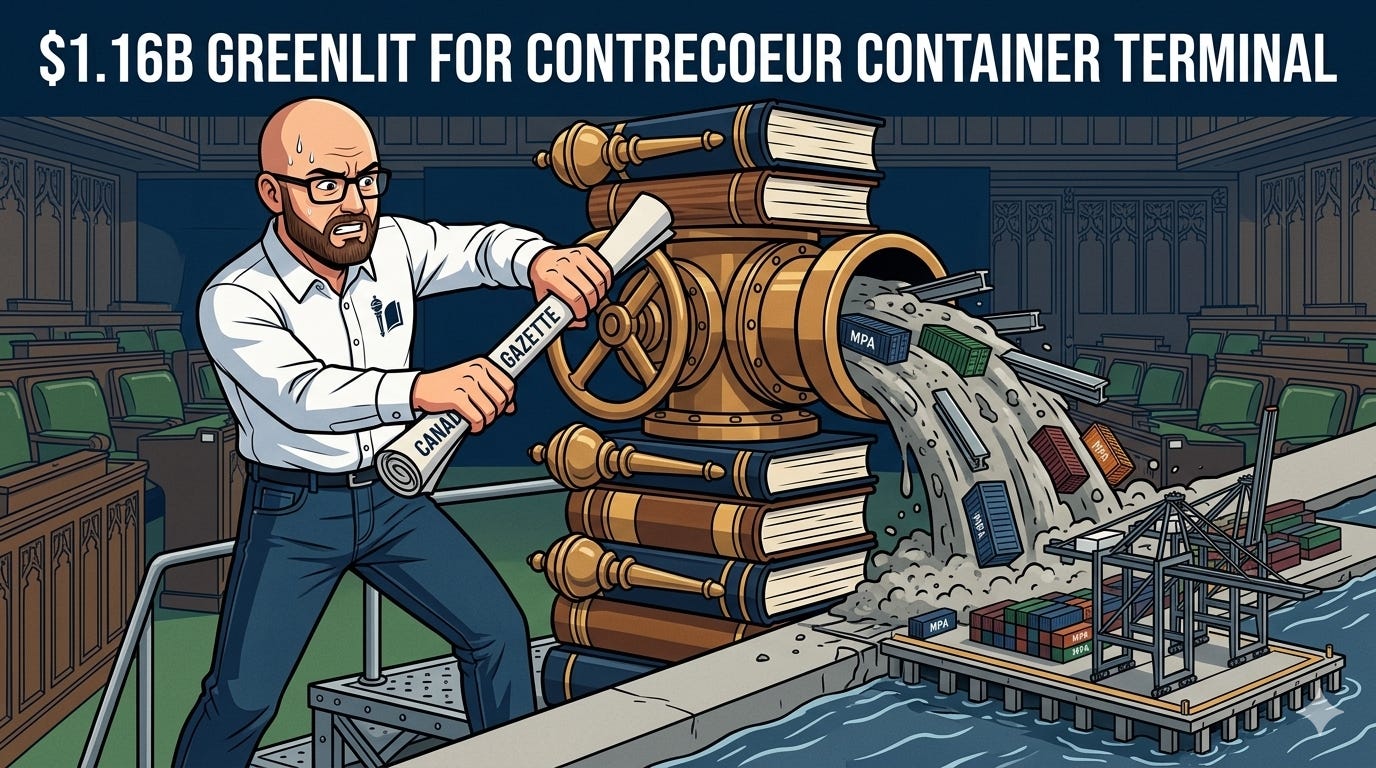
In the marble corridors of federal power, where a single paragraph in the Saturday Canada Gazette can unlock billions in infrastructure spending, one quiet notice has just reshaped Canada’s trade future. The Montreal Port Authority now holds explicit federal permission to borrow up to an additional $1.16 billion from the Canada Infrastructure Bank for the construction of the Contrecoeur Container Terminal. This targeted financing, buried deep in supplementary letters patent under the Canada Marine Act, marks a decisive step toward expanding container capacity on the St. Lawrence River amid growing global supply chain pressures.
The $1.16 Billion Borrowing Limit for Contrecoeur Container Terminal
The amendment appears in the March 21, 2026 edition of the Canada Gazette Part I, Vol. 160, No. 12. Original letters patent for the Montreal Port Authority date back to March 1, 1999. Section 9.2 of those letters patent already capped the Authority’s general borrowing power for port purposes. On February 26, 2026, the Governor in Council, through Order in Council P.C. 2026-173, approved new provisions that create a dedicated additional limit tied exclusively to the Contrecoeur project.
Minister of Transport the Honourable Steven MacKinnon, P.C., M.P., signed the supplementary letters patent effective March 6, 2026. The new clause, inserted as section 9.2.3, reads clearly: notwithstanding existing limits and in addition to all prior borrowing authority, the Authority may borrow up to a maximum of $1,160,000,000 plus any interest owed to the Canada Infrastructure Bank. The terms mirror the Summary of CIB Indicative Terms, Contrecoeur Container Terminal Project, which the Authority’s board approved on November 27, 2025 under resolution CA-2025-65. Proceeds will fund costs directly associated with building the new terminal.
This structure ensures the financing remains ring-fenced for the project while protecting the Authority’s overall financial position. The move comes after the board formally requested the increase, demonstrating how port authorities must navigate precise federal oversight before accessing large-scale infrastructure funding.
Step-by-Step Path from Board Request to Ministerial Approval
The approval process unfolded with textbook federal precision. First, the Montreal Port Authority’s board identified the need for dedicated borrowing capacity to support the Contrecoeur expansion. Next came the formal request for supplementary letters patent. Governor in Council review followed on February 26, 2026. Finally, Minister MacKinnon issued the amendment, confirming it aligned with the Canada Marine Act. The entire chain, from board resolution to publication in the Canada Gazette, took just weeks, highlighting the streamlined yet rigorous pathway for nationally significant port projects.
For the St. Lawrence River corridor, the implications are immediate. The new terminal will add substantial container handling capacity east of Montreal, easing current bottlenecks and positioning Canada to capture more international trade flows. In an era of nearshoring and supply chain resilience, this $1.16 billion commitment underscores federal priority on strategic infrastructure.
Parallel Power Moves: New Leadership for Financial Crimes Agency
The same Canada Gazette edition announces high-level appointments that reveal Ottawa’s broader priorities. Global Affairs Canada Senior Advisor Robert Stewart now carries the title Deputy Minister responsible to lead the creation of the new Financial Crimes Agency. This styling, granted through Order in Council 2026-191, signals the government’s determination to strengthen enforcement against financial crime at the highest levels.
Other appointments fill critical roles across government: new judges in Prince Edward Island, Nunavut, and the Northwest Territories; senior advisors at Correctional Services Canada and Global Affairs Canada; and deputy ministers in defence, public works, immigration, and veterans affairs. The Privy Council Office also lists new senior officials and sherpa roles for G7 and G20 summits. Together these moves illustrate a government quietly reshaping its leadership bench.
Sweeping Charity Revocations Under Income Tax Act
Enforcement actions fill pages of this edition. The Canada Revenue Agency proposes revocation of charitable status for dozens of organizations under the Income Tax Act. Notices cite failures to meet reporting obligations or operational requirements under paragraphs 168(1)(b), 168(1)(c), 168(1)(d), 168(1)(e), and related sections.
One table alone lists over 100 entities, from small faith-based groups and community churches to scholarship funds and cultural foundations across every province and territory. Business numbers and addresses appear alongside each name. Some revocations follow requests from the charities themselves; others stem from CRA audits. The scale of these actions, published in a single Saturday Gazette, underscores the Agency’s ongoing oversight of the charitable sector.
Trade Tribunals Continue Protection on Imports from China
Economic protection measures also feature prominently. The Canadian International Trade Tribunal continued, with amendment, its order on carbon steel screws from China and Chinese Taipei. A new inquiry has begun into truck bodies originating from China, examining whether dumping and subsidizing have caused or threaten injury to Canadian producers. Preliminary injury inquiries cover forged grinding media, while an interim review amended orders on photovoltaic modules and laminates.
These proceedings, complete with hearing dates, participant deadlines, and detailed product descriptions, demonstrate the Tribunal’s active role in safeguarding domestic industry under the Special Import Measures Act.
Electoral and Parliamentary Updates
Parliamentary notices confirm the deregistration of the Libertarian Party of Canada, effective March 31, 2026, after failure to meet obligations under section 415 of the Canada Elections Act. An erratum corrects cannabis licensing fees from an earlier edition. The Treasury Board Secretariat publishes quarterly superannuation interest rates. Appointment opportunities remain open for Commissioner of Competition and roles at the Office of the Commissioner of Indigenous Languages.
The Canada Gazette rarely makes front-page news. Yet every Saturday its pages quietly record decisions that steer billions in spending, reshape leadership, enforce tax compliance, and protect trade. In Volume 160, Number 12, the $1.16 billion approval for the Contrecoeur Container Terminal stands as the clearest signal of federal commitment to port infrastructure and national economic resilience. Surrounding notices on financial crime leadership, charity oversight, and import protections complete the picture of a government balancing growth with accountability.
Hansard Files digs through dense official archives like the Canada Gazette to uncover these pivotal stories. Subscribe to support more independent investigations into government records.
Source Documents
Canada Gazette. (2026, March 21). Canada Gazette Part I, Vol. 160, No. 12.
"The entire chain, from board resolution to publication in the Canada Gazette, took just weeks, highlighting the streamlined yet rigorous pathway for nationally significant port projects."
While it may be poetic to refer to "marble halls" of government, the Parliament buildings themselves are constructed of Tyndall stone, a dolomitic limestone from Manitoba. The only possibly relevant building in Ottawa that I am aware of, with marble on both its exterior and its interiors, is the Library and Archives building at 395 Wellington. Of course, I could be wrong. 😉